
A young woman lies on a sofa reading a book, enjoying a peaceful indoor moment
The good news is that reading habits are built with small, consistent actions, not willpower alone. Twenty minutes a day adds up to roughly fifteen to twenty books a year for many readers. This guide shows you how to make reading a natural part of your daily life.
Step 1: Choose Books You Actually Want to Read
Small daily reading sessions add up
The fastest way to kill a reading habit is forcing yourself through books you don't enjoy. Especially at the start, pick books that genuinely interest you, whether that's a thriller, romance, fantasy, biography, graphic novel, or practical non-fiction.
- Start with shorter or lighter books to build momentum.
- Follow your curiosity: a film you loved, a place you want to visit, or a skill you want to learn can lead to a great book.
- Ask for recommendations from friends, librarians, and booksellers, or browse reader review communities.
- Give yourself permission to stop: if a book doesn't grab you after 50 pages or so, set it aside and try another. Life is too short for books you dislike.
Step 2: Attach Reading to Daily Routines
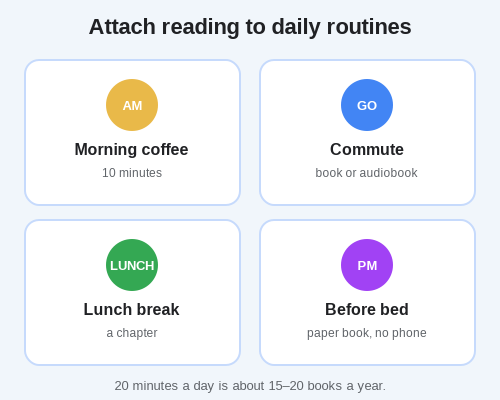
Habits stick best when they're linked to something you already do. Choose one or two "anchors" for reading:
- Morning: ten minutes with your coffee or tea before checking your phone.
- Commute: a book or audiobook on the bus or train.
- Lunch break: a chapter instead of scrolling.
- Before bed: a paper book or e-reader instead of a phone, which can also help you wind down.
Start small: a goal of ten pages or ten minutes a day is easy to keep and often grows naturally as you get absorbed in a book.
Always have a book within reach
Keep a book in your bag, by your bed, and on your phone's reading app. Waiting rooms, queues, and short breaks become reading time when a book is always available.
Step 3: Reduce Distractions
- Put your phone in another room or on "do not disturb" while reading.
- Use an e-reader rather than a phone if notifications tempt you.
- Create a comfortable reading spot with good light and a supportive chair.
- Swap one evening of television or social media a week for reading.
- Notice how long you spend on your phone each day using its screen-time tools; most people can find 20 minutes there.
Step 4: Mix Formats and Use Your Library
Reading doesn't have to mean a printed book. Audiobooks are perfect for commutes, chores, exercise, and walks, and count just as much for enjoying stories and ideas. eBooks are convenient for travel and night reading. Mixing formats makes it easier to read in more situations.
Your public library is a reading habit's best friend: it offers free printed books, eBooks, and audiobooks, often through apps. Our guide on finding free eBooks explains how to borrow digital books legally.
Step 5: Track Progress and Set Gentle Goals
Seeing a streak builds motivation
- Set a realistic yearly or monthly goal, such as one book a month, and adjust it as you go.
- Focus on consistency rather than speed; reading regularly matters more than finishing quickly.
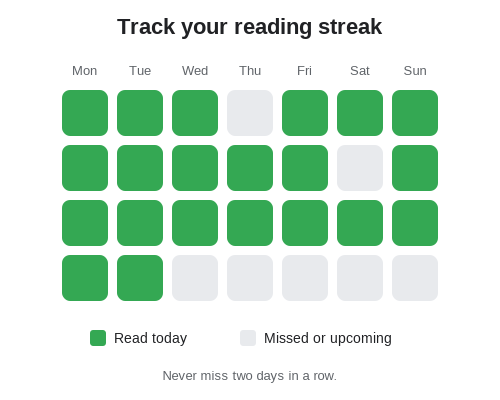
- Follow the "never miss twice" rule: if you skip a day, read the next.
- Celebrate milestones, like your first five books or a 30-day streak.
Make Reading Social
Sharing books makes reading more fun and keeps you accountable. Join a book club through your library, workplace, or community, or start one with friends. Online reading communities let you discuss books, join reading challenges, and discover new authors. Reading the same book as a partner or friend gives you something to talk about, and reading with children, even just a short story at bedtime, builds the habit for the whole family. If reading inspires you to write, see our guide on writing a short story.
Look after your eyes
Read in good light, take short breaks during long sessions, and look into the distance every 20 minutes or so. If you notice frequent headaches, blurred vision, or eye strain when reading, have your eyes checked by an optometrist.
Overcome Common Reading Obstacles
If you often fall asleep while reading, try reading earlier in the day or sitting upright rather than lying down. If you struggle to concentrate, start with shorter chapters, essays, or short story collections, and gradually build up your reading stamina. Audiobooks at a comfortable speed can also help.
If you feel you have "no time", track your phone screen time for a week. Most people find spare minutes that can be swapped for reading. And if you have lost interest in reading after years away, try returning to books you loved when you were younger, or explore graphic novels and poetry for a fresh experience.
Remember there is no "right" way to be a reader. Rereading favourites, mixing genres, and reading several books at once are all perfectly valid.
Finally, be kind to yourself during busy periods. Life sometimes leaves little time for reading, and that is fine. Even a few pages before bed keeps the habit alive until you have more time again.
Over months and years, those small reading sessions add up to dozens of books and countless new ideas.
Final Thoughts
Starting a reading habit is about making reading easy and enjoyable: choose books you love, link reading to daily routines, reduce distractions, mix printed books with eBooks and audiobooks, track your progress, and share books with others. Begin with just ten minutes today, and let the habit grow one page at a time.