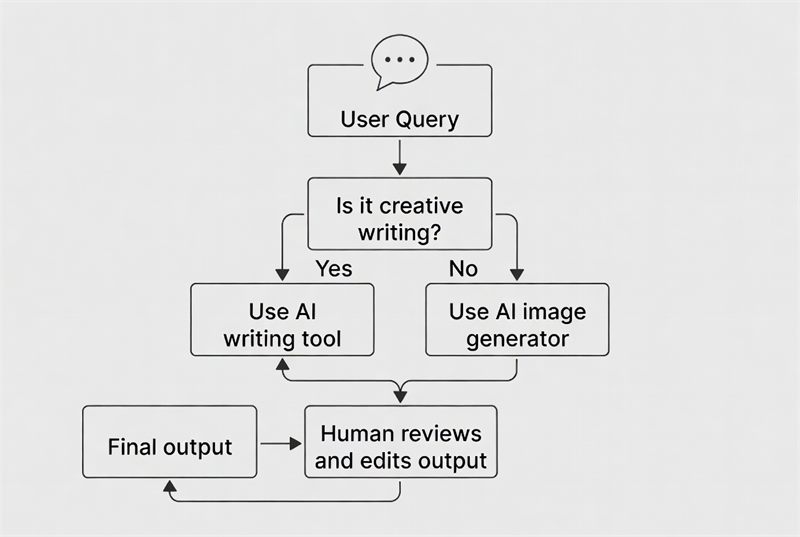
Human-guided AI content creation process
Introduction
Creating content today presents unique challenges. Readers expect clear, helpful information delivered quickly, while content creators face the pressure of consistently producing quality material. Time is limited, ideas run out, and writing everything from scratch isn't always practical.
This is where AI can help — if used correctly. The challenge lies in finding the right balance between leveraging AI's efficiency and maintaining the authenticity and quality that builds trust with your audience.
The Human-AI Partnership
The most effective approach is human-guided AI, where AI assists but doesn't replace human judgment. This method allows you to create content faster while maintaining the quality and authenticity your audience expects.
Remember: AI is a tool that amplifies your capabilities, not a replacement for your thinking. It speeds up work, organizes ideas, and reduces effort, but only when humans maintain control of the final output.
This guide will teach you how to create content with AI effectively, covering practical techniques, common pitfalls to avoid, and methods to maintain your unique voice while leveraging AI's efficiency.
What "Creating Content With AI" Really Means
Using AI for content creation is a collaborative process, not a one-click solution. AI generates drafts based on your instructions, and you refine those drafts into content that meets your standards and serves your audience's needs.

The collaborative content creation process
The AI Assistant
Think of AI as a fast research assistant that can access vast amounts of information instantly. It excels at:
Breaking through writer's block with fresh perspectives
Suggesting different angles for your topics
Providing structure to your ideas
Creating outlines for long-form content
The Human Editor
However, AI lacks true understanding of your specific audience, brand voice, or subject matter nuances. That's where human intervention becomes crucial.
AI is best used for: turning rough ideas into readable drafts, organizing complex topics, and suggesting alternative approaches
AI performs poorly with: replacing real-world experience, making editorial decisions, understanding audience context, guaranteeing accuracy without verification
Key Insight
The most effective approach combines AI's speed with human judgment, experience, and creativity. This hybrid method produces more content without sacrificing the quality that builds trust.
Understanding Different Types of AI Content Tools
Different AI platforms excel at different tasks. Choosing the right tool depends on your specific content needs and workflow.
Text-Based AI Tools
These are the most common AI content tools, designed to generate and edit written material. They vary in capabilities, interfaces, and specializations.
ChatGPT - Excellent for conversational content and detailed explanations
Claude - Strong in factual accuracy and long-form writing
Gemini - Good for real-time information and integration with Google services
They are useful for creating blog posts, articles, guides, FAQs, documentation, and tutorials.
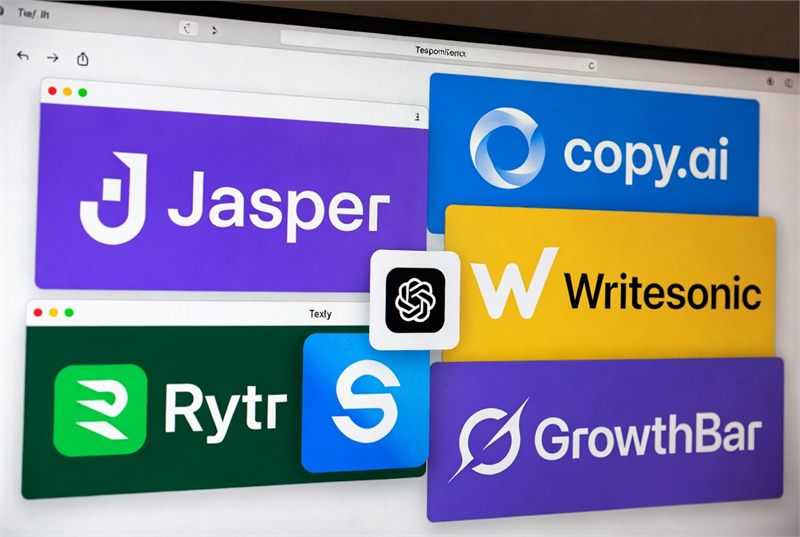
Popular text-based AI content tools
Image Generation Tools
These tools create visual content from text descriptions, supporting written content with relevant images and illustrations.
Midjourney - Excellent for artistic and stylized images
DALL-E - Great for photorealistic images and specific concepts
Stable Diffusion - Offers more control and customization options
They're often used for featured images, infographics, concept art, and social media visuals.
Specialized Writing Tools
Some AI tools focus on specific content types or industries, often providing better results for their niche.
Jasper - Focused on marketing copy and business content
Copy.ai - Designed for social media and advertising copy
Rytr - Good for short-form content and multiple languages
Writesonic - Strong in SEO-optimized content
Choose tools based on your content type. Long guides work best with advanced language models, while promotional content benefits from specialized marketing tools.
Why Human Control Is Always Necessary
Critical Warning
AI can sound confident even when completely wrong. This happens because AI predicts language patterns, not because it understands truth or has real-world knowledge.
Every AI-assisted piece of content must undergo human review. The human touch ensures accuracy, appropriate tone, and relevance to your specific audience.
Essential Quality Checks
Factual accuracy - Verify all claims against reliable sources
Logical consistency - Ensure the content flows and makes sense
Tone alignment - Match your brand voice and audience expectations
Ethical review - Remove biased or harmful content
Context verification - Add real-world examples and limitations
Think of it this way:
AI prepares drafts, while you act as editor, fact-checker, and creative director. This division ensures both efficiency and quality.
Your readers trust you because of your unique insights. Never compromise that trust by publishing unverified content.
Where AI Saves the Most Time
AI excels at repetitive or high-volume tasks, allowing you to focus on high-value activities that require human expertise.
Time-Saving Applications
Creating multiple content variations for different audience segments
Drafting basic "how-to" content for later enhancement
Writing comprehensive outlines for long guides and tutorials
Generating first drafts of product descriptions or documentation
Creating social media posts and newsletters from existing content
Translating content into different languages or formats
Pro Tip
Many creators use AI for repetitive tasks, then reinvest saved time in thorough editing and enhancement. This creates a virtuous cycle of quality and efficiency.
Remember: AI drafts are starting points, not finished products. The time saved should be reinvested in making the content truly valuable.
Using AI to Overcome Writer's Block
Writer's block affects every content creator. AI can be a powerful ally when you're stuck, staring at a blank page or feeling uninspired.

AI helping overcome writer's block
AI as Your Brainstorming Partner
Suggesting different angles and perspectives on your topic
Listing common questions your audience might have
Creating basic structures or outlines to build upon
Providing alternative phrasing for difficult concepts
Generating transition sentences to improve flow
Offering examples and analogies for complex topics
Use AI as a brainstorming partner, not a replacement. Ask for suggestions, then critically evaluate and incorporate only what genuinely serves your content.
Once structure exists, writing becomes easier. AI helps you start, but you guide the direction and make final decisions.
Writer's block often comes from perfectionism. Embrace the iterative process: draft, identify improvements, refine, repeat until satisfied.
How to Get Better Results From AI Prompts
The quality of AI output depends heavily on your prompts. Learning to write effective prompts is essential for AI-assisted content creation.
Prompt Engineering Best Practices
Be specific - Clearly define your audience and purpose
Provide context - Include background information and requirements
Set constraints - Specify what to avoid or include
Define tone - Indicate the desired voice and style
Iterate - Refine prompts based on initial results
Vague Prompt:
"Write about AI content"
Clear Prompt:
"Explain how beginners can create content with AI. Focus on practical steps, avoid jargon, include common challenges and solutions."
Effective Prompt Template
"Explain [topic] for [audience]. Focus on [key aspects]. Avoid [restrictions]. Include [specific elements] in [desired format]."
Clear prompts reduce editing time and ensure AI generates content matching your vision from the start.
Remember to iterate. If results aren't right, provide feedback and ask for adjustments. This conversational approach often yields better results than perfect prompts.
Improving Results Through Small Adjustments
The first AI response is rarely perfect. Think of AI as a capable assistant that needs guidance to produce exactly what you want.
Iterative Refinement Techniques
"Make this shorter and more concise"
"Explain this concept more simply"
"Add a practical example here"
"Remove repeated ideas"
"Rewrite in conversational tone"
"Include a warning about common mistakes"
AI First Draft:
"Artificial intelligence content creation represents a paradigm shift in digital marketing methodologies, leveraging advanced neural networks to generate syntactically coherent outputs."
After Human Edit:
"AI helps create content faster by generating drafts based on your instructions. It's especially useful when you're stuck or need multiple variations. However, human editing ensures accuracy, adds real-world context, and maintains your unique voice."
Step-by-step refinement transforms generic AI output into content that truly serves your audience, adding human value and authenticity.
Be specific but not overly restrictive. Guide AI enough to understand your needs while allowing room for creativity and unexpected insights.
Adding What AI Cannot Provide
AI has impressive capabilities but lacks genuine human experience. There are elements it simply cannot provide authentically.
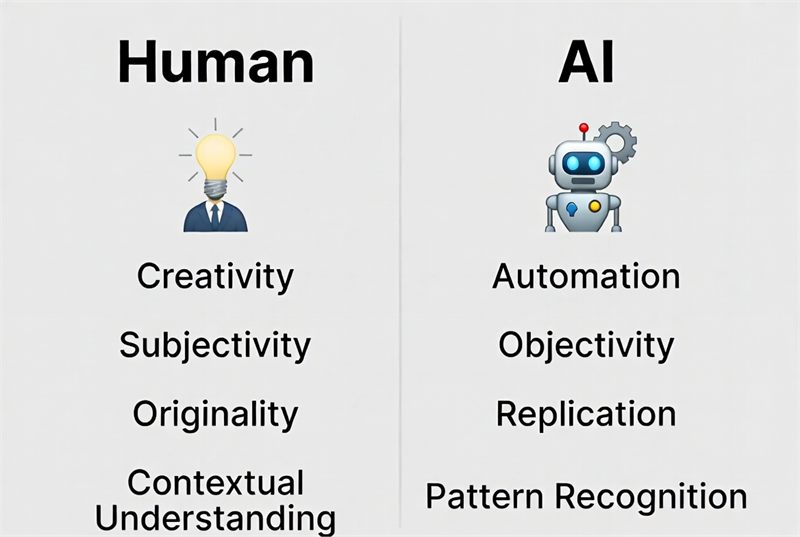
Human vs AI: Essential content elements
Essential Human Elements
Personal anecdotes - Real experiences from your journey
Common mistakes - Practical errors people make and solutions
Practical warnings - Based on actual implementation
Real-world limitations - Constraints of solutions in practice
Emotional resonance - Personal connection with readers
Industry insights - Specific knowledge from your field
Remember
These human elements separate helpful content from generic information. Always add them yourself - they make your content unique and valuable.
Think of it as enhancing AI's efficiency with your humanity. AI provides structure and speed; you provide depth, authenticity, and personal touch.
Editing AI Content So It Sounds Natural
After AI generates text, transform it into content that reflects your voice and serves your audience's needs.
Editing Checklist
Read entire text once without changes to understand flow
Remove artificial, robotic, or overly formal phrases
Break down long, complex sentences into shorter ones
Replace jargon with simpler alternatives
Check all facts against reliable sources
Ensure consistent tone throughout
Add transitions between ideas
Important
If it doesn't sound like something a real person would say, rewrite it. Your content should be accessible and natural, not academic or overly formal.
This editing process is where your unique voice shines through. AI provides raw material; you shape it into something that truly represents you and connects with your audience.
Keeping Content SEO-Friendly Without Ruining Readability
Search engines reward content that genuinely helps users, not content that tricks algorithms. Good SEO practices naturally align with creating high-quality, user-focused content.
| Good SEO Practice |
Bad SEO Practice |
| Answer real questions clearly |
Stuff keywords unnaturally |
| Use headings naturally |
Repeat phrases excessively |
| Focus on one topic per page |
Mix unrelated topics |
| Make content mobile-friendly |
Ignore readability |
AI can suggest titles and keywords, but always prioritize clarity and user value over search manipulation.
SEO Wisdom
The best SEO strategy is creating content that genuinely helps people. Search engines will reward this naturally.
Ethical Use of AI in Content Creation
Using AI ethically maintains trust with your audience and upholds professional standards. Ethical AI-assisted content should always be:
Transparent - About AI assistance when appropriate
Verified - Thoroughly fact-checked and accurate
Enhanced - With your unique perspective and expertise
Original - Not just copied from AI without changes
Transparency builds long-term trust with your audience.
Verification ensures accuracy and credibility.
Copying large AI outputs without changes damages trust. Prioritize your audience's needs and reputation over shortcuts.
Ethical Priority
Your reputation as a content creator is your most valuable asset. Never compromise it for speed or volume.
Final Thoughts
AI makes content creation faster, but quality depends on human judgment. The most successful creators use AI to enhance their capabilities, not replace their thinking.
The Winning Formula
Clear strategic thinking before using AI
Well-crafted, specific prompts
Careful editing and refinement
Simple, accessible language
Focus on helping the reader
Consistent brand voice and values
When AI supports human judgment instead of replacing it, content becomes easier to create — and much better to read. The future belongs to those who skillfully blend human creativity with AI assistance.