
Start by writing everything down:
- Total amount you owe
- Number of debts
- Interest rates
- Minimum monthly payments
- Due dates
Then write:
- Your monthly income
- Your essential monthly expenses
If the remaining amount:
- Covers all minimum payments → you can move forward independently
- Does NOT cover minimums → you need immediate adjustments or support
Common places people free money:
- Subscriptions they rarely use
- Insurance plans that haven't been reviewed in years
- Small daily spending leaks
- Services paid automatically and forgotten
Even small savings, when redirected to debt, create momentum.
Realistic options include:
- Temporary side work
- Selling unused items
- Short-term freelance tasks
- Skill-based small jobs
Ways people reduce interest pressure:
- Negotiating with lenders
- Combining multiple debts into one manageable payment
- Switching to lower-interest options when eligible
Lower interest means:
- Faster progress
- Less money wasted
- More control
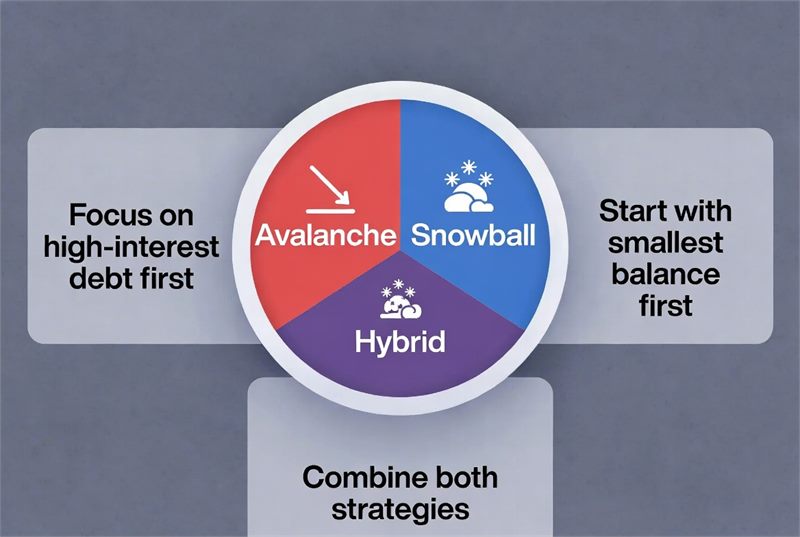
Two proven approaches:
Method A: High-Interest First
You focus on debts that cost the most over time.
Best if: Interest rates are high, You want long-term savings
Method B: Small Balance First
You clear smaller debts first to build confidence.
Best if: Motivation is low, Progress feels slow
Even small extra amounts:
- Reduce interest
- Shorten repayment time
- Improve confidence
A small emergency reserve:
- Prevents new debt
- Keeps progress intact
- Reduces stress
Rules that help:
- Pause credit use
- Avoid "just this once" purchases
- Close paid-off accounts only if temptation is high
- Payments are impossible
- Legal pressure is rising
- Income is very low
Structured repayment plans or formal debt solutions may be necessary. These exist to protect people, not punish them.
There is no fixed timeline.
It depends on:
- Total debt
- Interest rates
- Monthly payment ability
- Consistency
Helpful debt
Supports long-term value or income potential.
Harmful debt
Finances short-term consumption with long-term cost.
The goal isn't perfection — it's reducing the debt that drains your future.

Paying off debt can take months or years, and it's normal to feel tired or discouraged along the way. You don't have to do it alone.
- Free debt advice: independent, non-profit debt advice services can review your situation, help you build a budget, and negotiate with creditors on your behalf. Look for regulated or government-recommended services.
- Talk to lenders early: if you can't make a payment, call before you miss it. Many lenders offer reduced payments, payment holidays, or lower interest for people in difficulty.
- Beware of "debt solution" scams: avoid companies that charge large upfront fees, promise to wipe out debt instantly, or tell you to stop talking to your creditors.
- Avoid new high-cost borrowing: payday loans and borrowing from one card to pay another usually make debt worse.
- Celebrate milestones: mark each paid-off account or every 10 percent of total debt cleared with a small, free reward.
- Visualise progress: a simple chart on the fridge showing your falling balance is surprisingly motivating.
- Involve your household: agree spending limits together so everyone understands the goal.
Once your debts are cleared, keep the habit going. Redirect the money you were paying each month into an emergency fund first, then into savings for future goals. That way, the next unexpected expense won't send you back into debt. Our guide on saving money fast has practical ideas to build that buffer.
If debt is affecting your mental health, sleep, or relationships, speak to someone you trust or a health professional. Money problems are common and solvable, and asking for support is a smart, practical step.
Final Thought
Getting out of debt isn't about punishment or sacrifice forever.
It's about:
- Control
- Awareness
- Consistent action
Once debt starts shrinking, confidence grows — and money stops feeling like an enemy.
Progress begins the moment you stop avoiding the problem and start managing it.