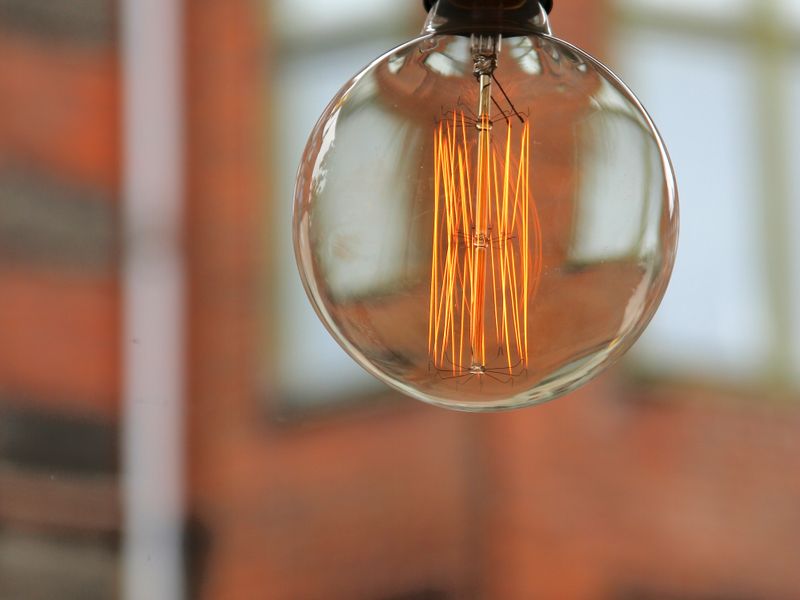
A round light bulb brightly illuminated, hanging indoors with a blurred brick background
This guide covers how to change bulbs safely, how to choose the right replacement, what to do when a bulb breaks in the socket, and how to dispose of old bulbs responsibly.
Before You Start: Safety Basics
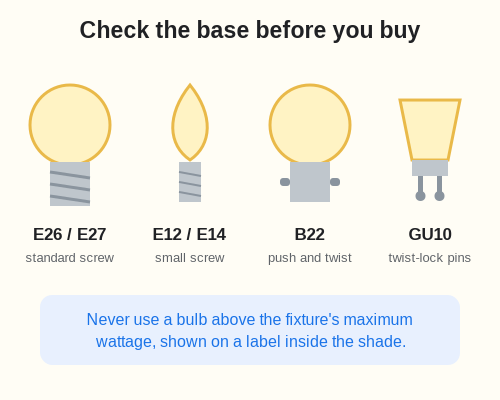
Match the base type before buying
- Switch off the light at the wall. For ceiling fittings or if a bulb is broken, also switch off the circuit at the consumer unit (fuse box or breaker panel).
- Let the bulb cool. Halogen and incandescent bulbs get very hot; wait at least five to ten minutes.
- Use a proper step ladder, not a chair, stool, or table. Make sure it's fully open, locked, and on a level floor.
- Dry hands only. Never change bulbs with wet hands or while standing on a wet floor.
- Check the fixture's maximum wattage, usually printed inside the shade or on the fitting. Exceeding it can overheat the fitting and create a fire risk.
Choosing the Right Replacement Bulb
Take the old bulb to the shop or photograph its markings. Check three things:
- Base (cap) type: common types include standard screw (E26 in North America, E27 in much of the world), small screw (E12/E14), bayonet (B22, common in the UK, India and elsewhere), and two-pin spotlights (GU10).
- Shape and size: the bulb must physically fit the shade or fitting.
- Brightness and colour: see below.
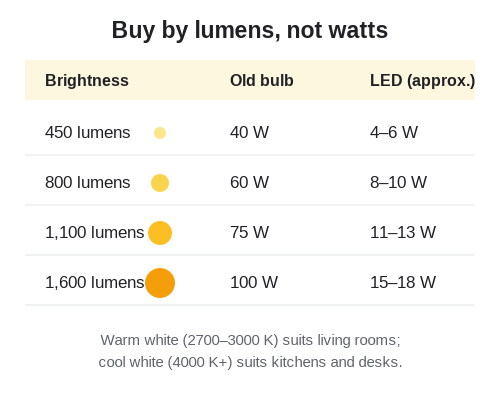
Lumens measure brightness
For colour, check the "kelvin" (K) number: warm white (2700–3000 K) gives a cosy, yellowish light for living rooms and bedrooms, while cool white or daylight (4000–6500 K) suits kitchens, bathrooms, and work areas.
Why switch to LED?
LED bulbs use far less electricity than old incandescent bulbs and last many times longer, so you change them less often. If you have dimmer switches, choose bulbs labelled "dimmable", as standard LEDs can flicker or buzz on dimmers.
Step-by-Step: Changing the Bulb
1
Switch Off and Wait
Turn the light off, and off at the circuit for ceiling fittings. Wait for the bulb to cool.
2
Set Up the Ladder
Position it so you can reach without stretching or leaning sideways. Keep your hips between the ladder rails and don't stand on the top platform or top step. Ask someone to hold it if possible.
3
Remove Any Shade or Cover
Glass covers are often held by small screws or clips; support the cover with one hand while releasing it so it doesn't fall.
4
Remove the Old Bulb
- Screw bulbs: turn anticlockwise gently.
- Bayonet bulbs: push up slightly, twist anticlockwise, and pull down.
- GU10 spotlights: push in and twist anticlockwise. A small suction cup tool helps grip flush bulbs.
5
Fit the New Bulb and Test
Insert it the same way, finger-tight only; overtightening can damage the socket. Avoid touching halogen bulb glass with bare fingers, as skin oils shorten their life. Refit the cover, climb down, restore power, and test.
How to Remove a Broken Bulb
1
Cut the Power at the Circuit
Switching off at the wall isn't enough, because exposed contacts may still be live. Turn off the circuit at the consumer unit or remove the fuse.
2
Protect Yourself
Wear safety glasses and thick gloves, and put a cloth or sheet below to catch glass.
3
Remove the Base
Grip the metal base with needle-nose pliers and turn it anticlockwise, or bend the edge inwards slightly to get a grip. Work slowly. If the base won't move or the socket is damaged, call an electrician.
Broken energy-saving bulbs
Compact fluorescent bulbs (CFLs) contain a small amount of mercury. If one breaks, open windows, leave the room for 15 minutes or more, don't use a vacuum cleaner, and collect pieces with card and sticky tape into a sealed container. Follow your local authority's disposal advice.
Disposing of Old Bulbs
- LED and CFL bulbs: take them to recycling points at many hardware stores or local recycling centres, as they contain electronics or mercury.
- Incandescent and halogen bulbs: usually go in general waste, wrapped so the glass can't cut anyone; check local rules.
If a bulb keeps blowing quickly, flickers, or the fitting buzzes, smells of burning, or looks scorched, stop using it and have an electrician check the wiring.
New Bulb Still Not Working?
Before calling an electrician, check these common causes in order:
- Is the bulb seated properly? Screw bulbs need to be turned until snug; bayonet pins must lock into both slots.
- Has the circuit tripped? Check the consumer unit or breaker panel for a switch in the "off" position, or a blown fuse. A bulb blowing can sometimes trip a circuit.
- Is it the right bulb? Check the base type and that LED bulbs are labelled "dimmable" if the light is on a dimmer.
- Try the bulb elsewhere: new bulbs are occasionally faulty.
- Socket contact (screw fittings): with the circuit switched off at the breaker, the small brass tab at the bottom of the socket can sometimes be flattened. Only check this if you're comfortable, and never with the power on.
If lights flicker across several rooms, switches feel warm, or you notice a burning smell, stop using the circuit and contact a qualified electrician.
Final Thoughts
Changing a bulb safely comes down to three habits: power off, bulb cool, and a proper ladder. Choose replacements by base type and lumens, switch to LEDs where you can, and take extra care with broken bulbs. Five minutes of caution prevents the most common household accidents.