
A soccer ball resting on a grass field, captured during nightfall with visible dew
This guide explains the main rules, what each position does, the core skills to practise, and how to get started playing, whatever your age or ability.
Step 1: Learn the Basic Rules
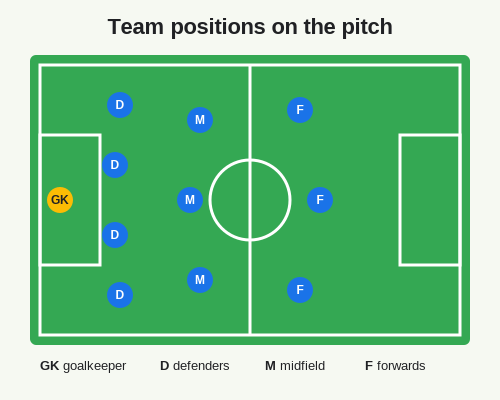
Each position has a different main job
- The aim: score more goals than the other team by getting the ball into their goal.
- Teams: a full match has 11 players per side, including a goalkeeper. Casual and youth games often use smaller teams, such as five-a-side or seven-a-side.
- Using your hands: only the goalkeeper can handle the ball, and only inside their own penalty area. Everyone else uses their feet, legs, body, and head.
- Match length: a full adult match is two halves of 45 minutes; shorter games are common for juniors and casual play.
- Restarts: throw-ins when the ball crosses the sideline, goal kicks and corner kicks when it crosses the goal line, and free kicks after fouls.
- Fouls: tripping, pushing, holding, dangerous tackles, and handball lead to free kicks or penalties. Serious fouls can bring a yellow card (caution) or red card (sent off).
Offside, simply explained
A player is offside if, when a teammate passes the ball forward, they're in the opponent's half and closer to the opponent's goal line than both the ball and the second-last defender (the goalkeeper usually counts as one). Being level is onside. Many casual games don't use offside at all.
Step 2: Understand the Positions
- Goalkeeper: stops shots, organises the defence, and starts attacks with throws and kicks.
- Defenders: stop opponents from attacking, win the ball back, and pass it forward safely. Full-backs on the sides often join attacks.
- Midfielders: connect defence and attack, cover a lot of ground, pass, tackle, and support both ends.
- Forwards: create and score goals, press defenders, and hold the ball up for teammates.
Beginners benefit from trying several positions. It helps you understand the whole game and discover where you're most comfortable.
Step 3: Practise the Core Skills
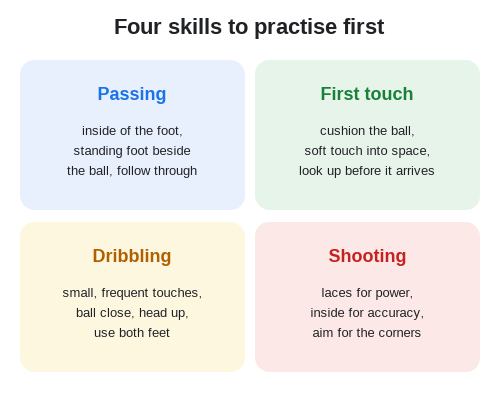
Master the basics before the tricks
- Passing: use the inside of your foot for accuracy. Plant your standing foot beside the ball, pointing at your target, and follow through.
- First touch: cushion the ball as it arrives, letting your foot "give" slightly, and push it into space ready for your next move.
- Dribbling: keep the ball close with small, frequent touches, using different parts of your foot. Practise keeping your head up to see teammates.
- Shooting: strike through the middle of the ball with your laces for power, keeping your body over the ball to keep it low. Aim for the corners.
- Heading: for older players, use your forehead with eyes open. Many youth organisations now limit or restrict heading practice for children; follow their guidance.
Step 4: Use Simple Drills to Improve
- Wall passing: pass against a wall, control the rebound, and repeat, alternating feet. Great for passing and first touch alone.
- Cone dribbling: set up a line of cones or bottles and dribble in and out, using both feet and changing speed.
- Juggling: keep the ball in the air with your feet, thighs, and head. It builds touch and control.
- Shooting practice: place targets in the corners of a goal and aim at them from different angles.
- Small-sided games: playing two-versus-two or three-versus-three gives many more touches of the ball than full matches.
Step 5: Get the Right Kit and Stay Fit
- Boots or trainers suited to the surface: studs for grass, moulded soles for artificial turf, and flat trainers for indoor courts.
- Shin pads protect against kicks and are required in organised matches.
- A suitable ball for your age group; smaller and lighter balls are used for children.
- Fitness: football involves repeated sprints, so mix running, interval training, and strength work. Our guide on starting running is a good base.
Play safely
Warm up before playing, drink plenty of water, and never play through sharp pain, especially in knees and ankles. Any player who receives a blow to the head and shows signs of concussion, such as confusion, dizziness, or headache, should stop playing immediately and get checked.
Find a Game and Enjoy It
Start with casual kickabouts in a park with friends, then look for organised options: local five-a-side leagues, walking football for older players, community clubs, school and university teams, and women's and girls' football groups, which have grown hugely in recent years. Many clubs welcome complete beginners. Our guide on joining local leagues explains how to find one.
Above all, respect the referee, your teammates, and opponents. Good sportsmanship makes the game better for everyone.
Learn by Watching the Game
Watching football with a purpose is a great way to improve. Instead of following only the ball, pick one player in your position and watch how they move when they don't have it: where they stand, how they scan the pitch, and when they make runs. Notice how teams keep their shape in defence and how quick passing creates space. Applying just one idea at your next game can make a real difference.
You can also learn a lot by reviewing your own games. If someone can film part of a match, watch it back and notice your positioning, decision-making, and body shape when receiving the ball. Ask a coach or experienced teammate for one or two things to work on, and focus on those in training until they become habit. Small, specific improvements add up quickly over a season.
Final Thoughts
Playing football starts with a few simple ideas: learn the basic rules, understand what each position does, and practise passing, first touch, dribbling, and shooting with both feet. Add simple drills, the right kit, and regular games, and you'll improve quickly while enjoying the world's favourite sport.