
A business professional signing a written agreement
Contract law differs between countries, and some agreements, such as property sales or certain loans, have special legal formalities. This guide covers the practical basics of drafting simple agreements safely and explains when you should get a lawyer involved.
Why Put Agreements in Writing
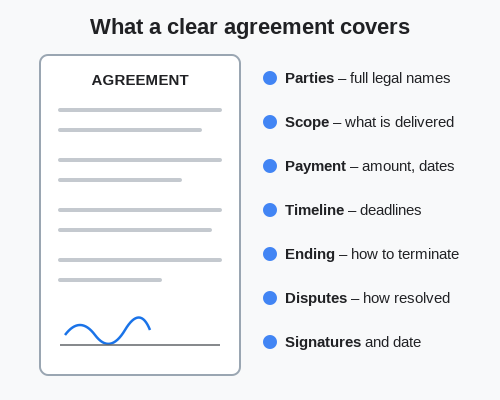
Seven parts most agreements need
Many verbal agreements can be legally binding, but they're hard to prove and easy to remember differently. A written agreement:
- Forces both sides to think through the details before starting
- Records exactly what was agreed about price, scope, and deadlines
- Makes it easier to resolve disagreements without going to court
- Is often required by law for certain deals, such as property, some leases, or guarantees
What Every Agreement Should Include
- The parties: full legal names, addresses, and for businesses the registered company name and number.
- The scope: exactly what will be delivered, done, or sold, with quantities, specifications, or standards.
- Payment: the amount, currency, due dates, method, any deposit, and what happens if payment is late.
- Timeline: start date, deadlines, and how delays will be handled.
- Responsibilities: who provides materials, permissions, or information.
- Changes: how either side can request changes and how they'll be priced.
- Ending the agreement: how and when each side can terminate, and what's owed if they do.
- Disputes: how disagreements will be handled, such as negotiation first, then mediation, and which country's or region's law applies.
- Signatures and dates from everyone involved.
Depending on the deal, you may also need clauses on confidentiality, ownership of work or intellectual property, warranties, and limits of liability.
How to Write Clear Terms
- Use plain language. Short, direct sentences are easier to understand and harder to misread than legal-sounding phrases.
- Be specific. Write "payment of 500 within 14 days of invoice" rather than "payment soon after completion".
- Define key terms that could be read in different ways, such as "completion" or "working days".
- Avoid contradictions between sections, and make sure attachments match the main text.
- Number clauses and pages so you can refer to them easily.
Using templates
Templates from government business portals, professional bodies, or reputable legal services can be a good starting point. Always adapt them to your situation, delete clauses that don't apply, and check they're designed for your country's laws.
Review, Sign and Store Properly
- Read the entire agreement before signing, including small print and attachments.
- Make sure the signer has authority, for example a director or authorised person for a company.
- Check signing formalities. Some documents need witnesses, a notary, or specific wording. Electronic signatures are widely accepted for many contracts, but not all types.
- Give everyone a signed copy and keep yours safe, digitally and on paper.
- Record any changes in writing, signed or confirmed by both sides.
Never sign under pressure
Don't sign anything you don't understand, documents with blank spaces, or agreements you're being rushed into. A genuine partner will give you time to read, ask questions, and get advice.
When to Get Legal Advice
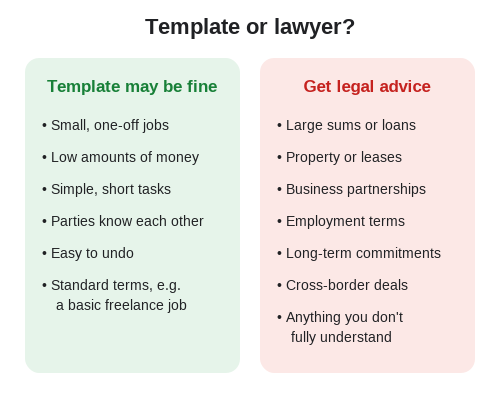
The bigger the risk, the more advice is worth
Paying for a review before signing almost always costs less than a dispute afterwards. Our guide on finding legal services online explains how to find a qualified lawyer.
Using Templates Safely
Templates can save time and remind you of common clauses, but they need careful handling. A template written for another country, industry, or situation may include terms that don't apply to you, or miss ones that do.
- Choose reputable sources: government business services, professional bodies, and established legal publishers offer more reliable templates than random websites.
- Check the jurisdiction: contract law varies between countries and regions. Make sure the template suits where you and the other party are based.
- Read every clause: delete what doesn't apply, and rewrite unclear wording in plain language.
- Fill in all blanks: leftover placeholders such as "[insert date]" can cause confusion or disputes.
- Keep it consistent: use the same names, dates, and defined terms throughout.
- Get advice for higher-risk agreements: property, employment, investment, and large-value contracts deserve a review by a qualified lawyer.
After signing, set reminders for important dates such as renewal deadlines, payment dates, and notice periods. Many disputes arise simply because one party forgot an obligation. Keep both signed copies, along with any later amendments, emails confirming changes, and receipts, in a safe and organised place.
If a disagreement does arise, start by re-reading the agreement and discussing it calmly with the other party. Many contracts include a dispute resolution clause, such as mediation, that should be followed before going to court.
Treat every agreement as a living record of your relationship with the other party. Clear, fair terms, written in plain language and agreed openly, make disputes less likely and protect both sides. When something important is at stake, the cost of professional advice is usually small compared with the cost of getting it wrong.
Final Thoughts
A safe agreement is clear, specific, and complete: who is involved, what's being exchanged, when, for how much, and what happens if things go wrong. Write in plain language, read everything before signing, keep copies, and get legal advice for anything important or complex.
Disclaimer
Waysily is an independent information website. We are not a government agency, we are not affiliated with any government, and we do not process applications or charge fees for any service. This guide gives general information only and is not legal, immigration, or tax advice. Rules, fees, and processing times differ between countries and change often, so always confirm requirements on your government's official website or with a qualified professional before you apply.