Cluttered desk with office stamps on top of various documents in an office setting
The exact rules depend on the country and the office receiving your documents. This guide explains the common terms and the general process so you know what to ask for.
What the Common Terms Mean
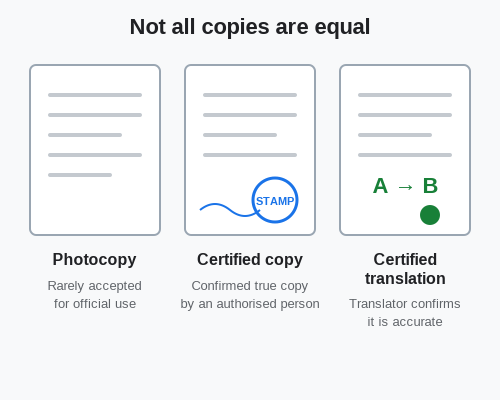
Offices often need more than a plain photocopy
- Original document: the document issued by the authority, such as your birth certificate or degree certificate.
- Official copy: a new copy issued by the authority that holds the record, such as a civil registry issuing another birth certificate. Many offices treat this like an original.
- Certified copy: a photocopy that an authorised person has checked against the original and signed or stamped to confirm it's a true copy.
- Notarised document: a document where a notary public has witnessed a signature or certified a copy.
- Certified translation: a translation with a signed statement from the translator or agency confirming it's complete and accurate.
- Apostille or legalisation: an extra certificate that confirms a public document is genuine so it can be used in another country.
Step 1: Find Out Exactly What Is Required
Before paying for anything, check the requirements of the office that will receive your documents. Look for answers to these questions:
- Do they want originals, official copies, or certified copies?
- Who is allowed to certify copies for them?
- Do translations need to be done by a sworn, accredited, or registered translator?
- Do foreign documents need an apostille or embassy legalisation?
- Is there a time limit, such as documents issued or certified within the last few months?
If the guidance isn't clear, contact the office and ask. A short email can save you paying twice.
Step 2: Get Certified Copies
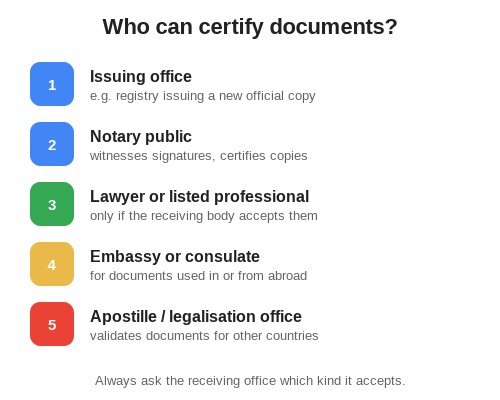
Acceptable certifiers differ between countries
- The authority that issued the document, which may provide official copies
- A notary public or commissioner for oaths
- A lawyer, or certain listed professionals, where the receiving office accepts them
- An embassy or consulate, for citizens abroad
- Some government service centres or post offices, in certain countries
Bring the original document and your ID. The certifier usually writes a statement such as "certified true copy of the original", then signs, dates, and adds their name, role, and contact details or stamp. Check that every page is certified if the document has several pages.
Step 3: Get Certified Translations
- Use a qualified translator who meets the receiving office's rules. Some countries require sworn or court-appointed translators; others accept members of a recognised professional body or an established translation company.
- Translate the whole document, including stamps, signatures, and handwritten notes.
- Check names and dates carefully. Names should be spelled the same way as in your passport.
- Keep the translation attached to a copy of the original, as many offices require both together.
- Don't translate your own documents for official use, even if you're fluent; most offices won't accept it.
Ask for a quote and timeline
Translation prices are often per page or per word. Ask for the total cost, whether certification is included, and when you'll receive both digital and paper copies, especially if you have a deadline.
Step 4: Apostille or Legalisation for Use Abroad
If a document from one country will be used in another, the receiving country may ask you to prove it's genuine. Countries that are part of the Hague Apostille Convention usually accept an apostille, issued by a designated authority in the country where the document came from. Countries outside the convention may require legalisation through the relevant ministry and the embassy of the country where you'll use it.
- Find the designated apostille or legalisation authority on your government's official website.
- Check whether the document must be certified or notarised before it can be apostilled.
- Check whether the translation should be done before or after the apostille; requirements differ.
- Allow extra time, especially if you're doing this from abroad.
Avoid fake certification services
Never use services that offer to "produce" certificates or stamps without the original document. Forged or altered documents can lead to refusals, bans, or criminal charges. Use only official authorities and properly qualified professionals.
Costs, Timing, and Avoiding Rejections
Fees for certification, translation, and apostilles vary widely depending on the country, the type of document, and urgency. Ask for a written quote before you start, including any courier or return postage costs. Translations are often priced per word or per page, and urgent services cost more.
Allow plenty of time, especially if you need several steps, such as certification, translation, and then an apostille. Check the requirements of the organisation receiving the documents before you begin: some need originals, some accept copies, and many have rules about how recent documents must be.
Keep your originals safe while documents are being certified or translated, and use tracked, signed-for postage when sending anything important. Ask for digital copies of translations as well as paper versions, so you can resend them quickly if needed.
Final Thoughts
Certified copies and translations are simple once you know exactly what the receiving office wants. Check its requirements first, use an accepted certifier and a qualified translator, get an apostille or legalisation for use abroad when needed, and keep copies of everything. Before you send your application, run through our guide on checking application documents.
Disclaimer
Waysily is an independent information website. We are not a government agency, we are not affiliated with any government, and we do not process applications or charge fees for any service. This guide gives general information only and is not legal, immigration, or tax advice. Rules, fees, and processing times differ between countries and change often, so always confirm requirements on your government's official website or with a qualified professional before you apply.