
Dimly lit cinema hall with red seats and a blank screen
This guide explains the main types of review sources, how to combine critic and audience opinions, how to find reviewers whose taste matches yours, and how to avoid spoilers and misleading ratings.
Step 1: Start With Review Aggregators
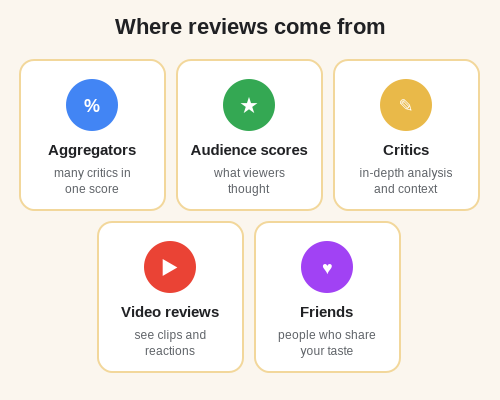
Each source tells you something different
Review aggregators collect many reviews in one place and summarise them in a score. They're a quick way to see the overall reaction to a film.
- Percentage-based scores, like Rotten Tomatoes' Tomatometer, show the share of critics who gave a positive review. A high score means most critics liked it, not necessarily that they loved it.
- Weighted average scores, like Metacritic's Metascore, average critics' ratings, giving a better sense of how much they liked it.
- Audience databases, like IMDb and Letterboxd, show ratings from large numbers of viewers, along with cast, crew, and trivia.
Use aggregators as a first filter rather than a final verdict. A film with a middling score may still be perfect for you if it's in a genre you love.
Step 2: Compare Critic and Audience Opinions
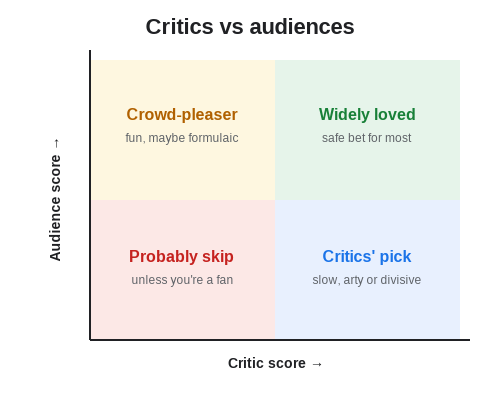
The gap between scores tells a story
- Both high: widely liked, usually a safe choice.
- Critics high, audiences lower: often slower, artier, or challenging films. Great if you like that style.
- Audiences high, critics lower: often crowd-pleasers, action, comedy, or franchise films that are fun but familiar.
- Both low: probably worth skipping unless you're a fan of the series, cast, or genre.
Watch out for review bombing
Audience scores can be distorted by coordinated campaigns of very negative or very positive ratings, often for reasons unrelated to the film. If an audience score looks oddly extreme, read a selection of the reviews themselves.
Step 3: Find Critics Who Share Your Taste
The most useful reviewer isn't the most famous; it's one whose likes and dislikes match yours. Here's how to find them:
- Look up reviews of five or six films you loved and a few you disliked.
- Note which critics or reviewers agreed with you most often.
- Follow those reviewers in newspapers, magazines, websites, podcasts, or video channels.
- Read beyond the score: good reviews explain why the film works or doesn't, which lets you judge whether those reasons matter to you.
Social film-logging apps make this even easier. By following friends and reviewers with similar tastes, your feed fills with recommendations that suit you.
Step 4: Avoid Spoilers
- Read the first and last paragraphs of a review, which usually give the verdict without plot details.
- Look for "spoiler-free" reviews, which many publications and video reviewers label clearly.
- Be careful with comments sections and social media, where spoilers spread quickly after a release.
- Avoid full trailers if you like surprises; teasers usually reveal less.
- Use mute or filter features on social apps to hide posts with a film's title for a while.
Step 5: Spot Misleading or Fake Reviews
Some reviews aren't what they seem. Promotional quotes on posters are carefully selected, sometimes from minor sources, and occasionally taken out of context. Online, some accounts post paid or coordinated reviews. Be cautious of reviews that are extremely short and extreme, posted in bursts on the same day, or repeated almost word for word. Sponsored reviews from influencers should be clearly labelled as adverts; if they aren't, treat them with caution.
Checking several independent sources is the best protection. If critics, audiences, and people you trust all agree, you can be fairly confident.
Check Age Ratings and Where to Watch
Before pressing play, it's worth checking two more things. First, the age rating and content guidance from your country's official film classification body, which explains themes like violence, language, and scary scenes, especially useful for families. Many classification websites and parent-focused review sites go into detail about specific scenes. Second, where the film is available. Streaming guide websites and apps show which services carry a title in your country, whether it's included in a subscription, available to rent, or free with adverts.
For free and legal options, see our guide on watching movies online for free.
Be careful with "watch now" links
Some review and listing sites carry adverts or links to unofficial streaming sites. Only follow links to services you recognise, and never download software to watch a film from a review page.
Trust Your Own Taste Too
Reviews are a guide, not a rule. Some of the most loved films were divisive on release, and many people enjoy films that critics dismiss. Keep a simple list or film-logging profile of what you watch and how much you liked it. Over time, you will notice patterns in the directors, genres, and actors you enjoy, and you will rely less on outside scores.
If you are choosing for a group, read a few reviews that describe the tone, pace, and content, rather than relying on star ratings alone. Knowing whether a film is a slow drama or a fast comedy often matters more for a shared evening than whether critics thought it was a masterpiece.
Talking about films with friends after watching them is also one of the best ways to sharpen your own judgement and discover what you really value in a story.
Final Thoughts
The best way to find movie reviews you can trust is to combine sources: use aggregators as a quick filter, compare critic and audience scores, follow reviewers whose taste matches yours, and read the reasoning rather than just the number. Add a little spoiler caution and a quick check of age ratings and availability, and you'll spend less time scrolling and more time enjoying films you actually like.