
Elderly man examines product in grocery store aisle
Label formats vary between countries, for example the "Nutrition Facts" panel in the United States and the "Nutrition Information" table used in the UK, EU, and many other places. But the core information is similar everywhere. Once you know where to look, reading a label takes only a few seconds.
Step 1: Start With the Serving Size
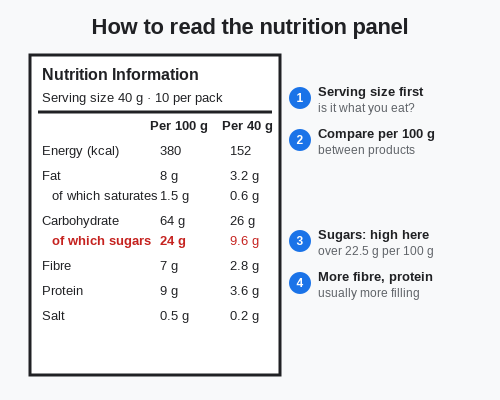
Four things to check on every panel
All the numbers per serving depend on the serving size stated on the label, which may be much smaller than the amount you actually eat. A bag of crisps or a bottle of drink may contain two or more servings, and a suggested cereal serving is often smaller than a typical bowl.
- Compare the stated serving with what you really eat, and adjust the numbers accordingly.
- Check how many servings are in the pack.
- In the US, some labels show both "per serving" and "per container" columns to make this easier.
Step 2: Compare Products Using Per 100 g
Where labels show values per 100 g or 100 ml, use that column to compare similar products, such as two breakfast cereals or two pasta sauces. Because serving sizes differ between brands, per-100 g figures are the only fair comparison. In the US, where labels show per serving only, compare products with similar serving sizes, and use the % Daily Value: as a rough guide, 5% or less is low and 20% or more is high.
Step 3: Understand the Key Nutrients
- Energy: shown in kilocalories (kcal, often just called calories) and sometimes kilojoules (kJ). Useful if you're managing your weight.
- Fat and saturated fat: total fat includes healthy fats from nuts, seeds, and oils. Saturated fat is the type to limit, as high intakes can raise cholesterol.
- Carbohydrate and sugars: "of which sugars" or "total sugars" includes natural sugars in milk and fruit as well as added sugars. US labels also list "added sugars" separately.
- Fibre: most people don't eat enough. Higher-fibre foods help digestion and keep you full; 6 g or more per 100 g is generally considered high fibre.
- Protein: helps you feel full and supports muscles.
- Salt or sodium: too much raises blood pressure. Some labels show sodium rather than salt; salt is roughly sodium multiplied by 2.5.
Step 4: Know What Counts as High or Low
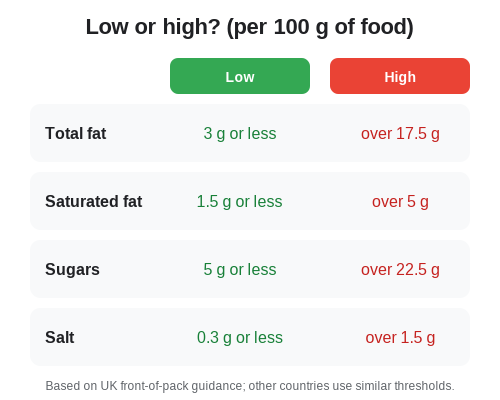
Simple thresholds make labels quicker to judge
Other systems include Nutri-Score letter grades in several European countries, health star ratings in Australia and New Zealand, and black "high in" warning labels in some Latin American countries. Whatever the system, the idea is the same: choose more greens or better scores, and eat "high" foods less often or in smaller amounts.
Step 5: Read the Ingredients List and Allergens
- Ingredients are listed by weight, from most to least. If sugar, salt, or fat appears near the start, the product contains a lot of it.
- Look for hidden sugars under other names: glucose, fructose, sucrose, dextrose, syrups, honey, molasses, and fruit juice concentrate. Several different sugars in one list can add up to a lot.
- Check for whole grains as the first ingredient in bread, pasta, and cereals, such as "wholemeal flour" or "whole grain oats."
- Allergens: in many countries, major allergens such as milk, eggs, peanuts, tree nuts, wheat, soya, fish, shellfish, and sesame must be clearly highlighted in the ingredients list or a "contains" statement. "May contain" warnings mean possible cross-contamination.
Shorter isn't always better
A short ingredients list can be a good sign, but not always. Some long lists simply include herbs and spices, and some short ones are mostly sugar and fat. Look at what the ingredients are, not just how many.
Don't Be Fooled by Front-of-Pack Claims
Claims such as "natural," "light," "multigrain," "made with real fruit," or "low fat" are marketing messages that don't always mean a product is healthy. A low-fat yoghurt may be high in sugar; "multigrain" bread may be mostly refined white flour; a "natural" snack can still be high in salt. Some claims, like "high fibre" or "reduced salt," are regulated in many countries, but they describe one nutrient, not the whole food. Always turn the pack over and check the nutrition panel and ingredients.
For more on cutting sugar specifically, see our guide on reducing sugar intake.
If you have allergies or a medical diet
Read the label every time you buy a product, even a familiar one, because recipes change. If you follow a diet for a medical condition, such as diabetes, kidney disease, or a severe allergy, ask your doctor or a registered dietitian which numbers on the label matter most for you.
A practical way to start is to pick the five or six packaged foods you buy most often, such as bread, breakfast cereal, yoghurt, pasta sauce, and snacks, and compare two or three brands of each using the steps above. Once you have found better options, you can simply buy those each week without needing to check every label again, apart from occasional checks in case recipes change. Small swaps on everyday foods usually make a bigger difference than occasional changes to treats.
Final Thoughts
Reading nutrition labels gets quick with practice: check the serving size, compare products per 100 g, look at saturated fat, sugars, salt, and fibre, scan the ingredients list and allergens, and look past marketing claims. Use these checks on the foods you buy most often, and small, informed swaps will add up to a healthier diet.