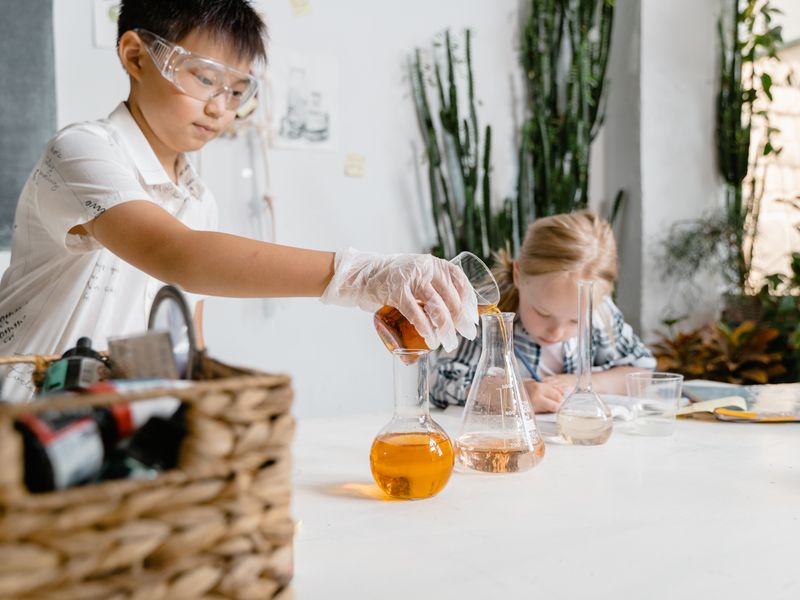
Good experiments start with a clear question
You don't need a professional laboratory to do real science. Students, hobbyists, and curious families run meaningful experiments at home, at school, and outdoors every day. What makes an experiment scientific is not expensive equipment but a clear method. This guide walks you through that method step by step, whether you're preparing a school science fair project or simply exploring a question that interests you.
Step 1: Ask a Testable Question
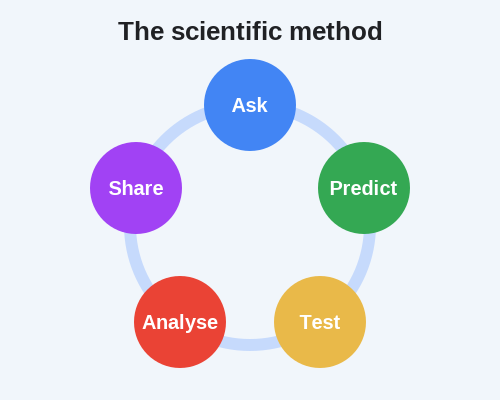
The scientific method is a repeating cycle
- Start with curiosity: something you've noticed, wondered about, or read.
- Make it measurable: include something you can count, time, weigh, or measure.
- Keep it manageable: choose a question you can test with the time, money, and equipment you have.
- Do some background research: find out what is already known, using textbooks, reliable websites, or library resources.
Step 2: Form a Hypothesis
A hypothesis is a clear, testable prediction based on what you already know. A useful format is: "If I change [this], then [this] will happen, because [reason]." For example: "If bean plants are given more sunlight, then they will grow taller in three weeks, because light provides energy for photosynthesis."
Your hypothesis doesn't have to be correct. In science, a result that disproves your hypothesis is just as valuable as one that supports it, because it still teaches you something about the world.
Step 3: Design a Fair Test
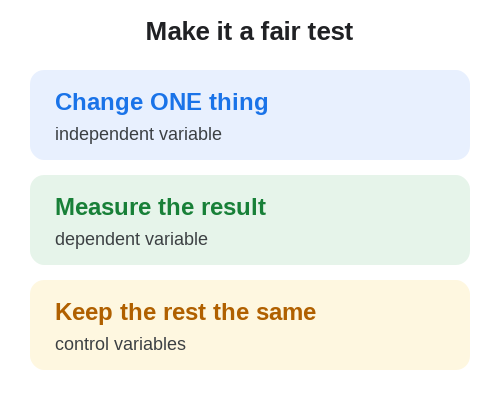
Only change one thing at a time
A fair test changes only one thing at a time, so you can be confident that thing caused any difference you see.
- Independent variable: the one thing you deliberately change, such as the amount of sunlight.
- Dependent variable: what you measure, such as plant height.
- Control variables: everything you keep the same, such as the type of seed, pot size, soil, water, and temperature.
- Control group: a comparison group that doesn't receive the change, if your experiment needs one.
- Repeats: test several samples or repeat the experiment, because one result can be a fluke.
Write a list of materials and a numbered step-by-step method before you start. Someone else should be able to follow your method and get similar results; that's called reproducibility.
Step 4: Run the Experiment and Record Data
- Follow your method exactly and note anything that didn't go to plan.
- Use a data table with clear headings and units, such as "Day", "Height (cm)".
- Measure carefully, using the same tool and technique each time, and record results straight away rather than from memory.
- Take photos at regular intervals as extra evidence.
- Keep a lab notebook with dates, observations, and anything surprising.
Record everything, even "mistakes"
Unexpected results, spilled samples, or equipment problems are worth noting. They help explain odd data and are part of honest science. Never change or invent results to fit your hypothesis.
Step 5: Analyse and Draw Conclusions
- Organise your data: calculate averages for repeated measurements.
- Make a graph: bar charts for comparing groups, line graphs for changes over time.
- Look for patterns: did changing the independent variable affect the dependent variable?
- Compare with your hypothesis: was it supported, partly supported, or not supported?
- Consider limitations: small sample sizes, measurement errors, or factors you couldn't control.
A good conclusion explains what you found, whether it matched your prediction, what might have affected the results, and what you would test next.
Share Your Results
Science moves forward when people share what they've learned. Present your experiment on a poster, in a short report, or as a talk, including your question, hypothesis, method, results, graphs, and conclusion. If you'd like to write a formal report, our guide on writing a research paper explains the standard structure. Comparing your findings with published research is a great next step; see our guide on using scientific journals.
For chemistry-based experiments, read our guide on doing chemistry experiments safely before you start.
Simple Experiment Ideas to Try
If you are looking for a starting point, simple experiments with household materials teach the method well. You could test which paper towel brand absorbs the most water, whether seeds germinate faster in light or dark, how the temperature of water affects how quickly sugar dissolves, or which shape of paper aeroplane flies furthest. Each of these has a clear independent variable, a measurable result, and things you can keep the same.
As you gain confidence, design experiments around your own questions. Science fairs, school projects, and citizen science programmes all welcome original ideas, and the process of planning, testing, and explaining your results builds skills that are valuable in any career. Keep a record of every experiment you carry out, including ones that did not work as expected, as they often lead to the most interesting next questions.
Science also rewards patience. Many experiments need several attempts before the method works smoothly, and real scientists frequently adjust their plans based on what they learn. Treat each run as a learning opportunity: note what went well, what could be improved, and how you would change the method next time. This habit of reflecting and refining is exactly what makes scientific knowledge more reliable over time.
Final Thoughts
Conducting a science experiment means asking a clear, testable question, making a prediction, designing a fair test that changes only one thing, recording data honestly, and drawing conclusions from the evidence. Follow these steps and even a simple experiment at home becomes real science, and the habits you build will serve you in every subject.