
Journals are where new research is published first
But journals can be intimidating: papers are long, full of technical language, and sometimes behind paywalls. This guide shows you how to find relevant research, access it legally (often for free), read papers efficiently, and judge whether a study is trustworthy.
Understand What Journals Publish
- Original research articles: report new experiments or studies.
- Review articles: summarise many studies on a topic, an excellent starting point for beginners.
- Systematic reviews and meta-analyses: combine results from many studies using strict methods; often the strongest evidence.
- Letters, commentaries, and editorials: shorter opinion or discussion pieces.
Peer review improves quality, but it doesn't guarantee a study is correct. Science advances as findings are repeated, challenged, and refined over time.
Step 1: Search Academic Databases
- Google Scholar: a free, broad search engine for academic literature across all subjects.
- PubMed: free database for medicine and life sciences.
- Subject databases: universities and libraries subscribe to specialist databases for engineering, chemistry, psychology, and more.
- Open-access directories: collections of freely available journals and articles.
Use specific keywords, combine them with AND, OR, and quotation marks for exact phrases, and filter by date and article type. When you find a useful paper, check its reference list and the "cited by" link to discover related research.
Step 2: Access Papers Legally and Often for Free
- Open-access articles are free to read for everyone and increasingly common.
- Your library: students and staff usually get access through their institution; many public libraries also offer database access.
- Preprint servers host early versions of papers before peer review; useful, but treat findings with extra caution.
- Author copies: many researchers share accepted versions on university repositories or will email a copy if you ask politely.
- Browser tools from libraries and open-access organisations can point you to legal free versions.
Use legal sources
Unofficial sites that bypass journal paywalls may break copyright law and institutional rules. Use the legal options above first; they cover a large share of research today.
Step 3: Read Papers Efficiently
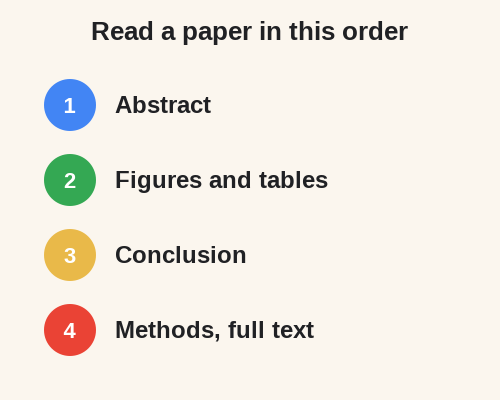
You rarely need to read a paper front to back
Keep a glossary of unfamiliar terms, and look up concepts in textbooks or review articles when needed. Taking brief notes on each paper, such as the question, method, key findings, and limitations, makes writing about them much easier later.
Step 4: Judge the Quality of a Study
- Sample size: larger studies are generally more reliable than very small ones.
- Study design: randomised controlled trials and systematic reviews provide stronger evidence than single observational studies or case reports.
- Correlation vs causation: two things happening together doesn't prove one causes the other.
- Funding and conflicts of interest: check the disclosures section.
- Journal reputation: be wary of "predatory" journals that publish almost anything for a fee with little real review.
- Consistency: do other studies find similar results?
Be careful with headlines
News stories often exaggerate single studies. When you see a surprising headline, find the original paper and check its size, design, and conclusions before believing or sharing it.
Organise and Use What You Find
Use a free reference manager such as Zotero to save papers, highlight PDFs, add notes, and generate citations in any style. Group papers by theme, and keep track of which ideas came from which source. When you use research in your own work, cite it accurately; our guide on writing a research paper explains citation and structure.
Tips for Beginners and Non-Scientists
If you are not a scientist, start with review articles and summaries rather than original research papers. Reviews explain the background, summarise what many studies have found, and highlight where scientists agree or disagree. Many journals also publish plain-language summaries alongside articles, and science news websites from reputable organisations often link directly to the original research.
Do not worry if you do not understand every detail, such as complex statistics or specialist methods. Focus on the main question, what the researchers did in simple terms, what they found, and what limitations they mention. Over time, as you read more papers in the same area, the vocabulary and methods become familiar, and you will understand more each time.
Librarians are an underused resource. University and public librarians can show you how to search databases effectively, find full-text articles, and use reference managers. Many libraries run free workshops on research skills, which are well worth attending if you plan to use journals regularly for study or work.
It also helps to set up alerts. Most databases and journal websites let you save searches and receive email updates when new papers matching your keywords are published. This is an easy way to stay up to date on a topic without searching repeatedly, and it means relevant research comes to you.
With regular practice, reading journals becomes faster and more rewarding, and you will be able to judge evidence for yourself rather than relying on second-hand summaries.
Finally, remember that science is a conversation. Letters, comments, and follow-up studies often respond to published papers, so checking what came after a study gives a fuller picture of its reliability.
Final Thoughts
Using scientific journals well means searching smart with the right databases, accessing papers legally through open access and libraries, reading strategically starting with the abstract and figures, and judging each study's quality before relying on it. With these skills, you can go straight to the evidence on almost any topic and understand it with confidence.