
A good paper is built on careful reading and planning
Writing a research paper can feel overwhelming because it involves several skills at once: reading, note-taking, planning, writing, and citing. Breaking the process into clear stages makes it manageable. This guide takes you from choosing a topic to submitting a polished final draft.
Step 1: Choose a Focused Topic
- Follow the brief: read your assignment or journal guidelines carefully, including word count, format, and deadline.
- Pick something you find interesting; you'll be spending a lot of time with it.
- Narrow it down: "climate change" is too broad; "how urban trees reduce summer temperatures in cities" is focused enough to research properly.
- Turn it into a research question, such as "How effective are urban trees at lowering street temperatures in summer?"
- Check that sources exist: do a quick search to make sure there's enough reliable material.
Step 2: Find and Evaluate Sources
Strong papers rely on credible evidence. Use your library's databases, academic search engines like Google Scholar, and reputable organisations' reports. Our guide on using scientific journals explains how to find and read academic articles.
- Prefer peer-reviewed sources and books from academic publishers.
- Check the author, date, and evidence: is the author an expert, is the information current, and are claims supported by data?
- Take organised notes: record the full reference, key points, and page numbers, and mark direct quotes clearly to avoid accidental plagiarism.
- Use a reference manager, such as Zotero or Mendeley, to store sources and create citations automatically.
Step 3: Write a Thesis and an Outline
Your thesis statement is a one- or two-sentence answer to your research question, the main point your paper will support. For example: "Urban tree cover significantly lowers summer street temperatures, making tree planting a cost-effective way for cities to adapt to heatwaves." Then plan your paper with an outline, listing the main sections and the evidence that supports each point. A good outline makes writing much faster.
Step 4: Follow the Standard Structure
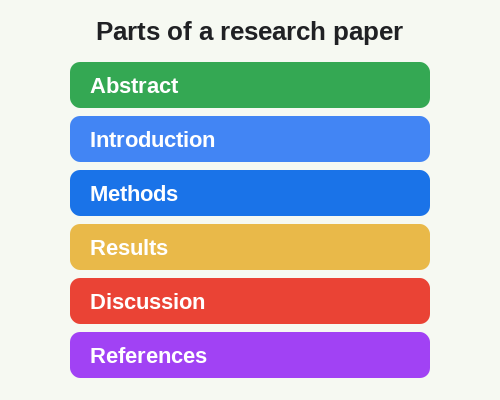
Most science papers follow this order
- Abstract: a short summary of the whole paper, usually written last.
- Introduction: background, why the topic matters, and your research question or thesis.
- Methods: how you collected and analysed information, detailed enough to repeat.
- Results: what you found, often with tables and figures, without interpretation.
- Discussion: what the results mean, how they compare with other research, limitations, and next steps.
- References: every source you cited, in the required style.
Step 5: Write Clearly and Cite Correctly
- Write a rough first draft without stopping to perfect sentences.
- Use clear, precise language: short sentences, defined terms, and one main idea per paragraph.
- Support every claim with evidence and a citation.
- Use the required citation style, such as APA, MLA, Chicago, Harvard, or a journal's own format, consistently throughout.
- Paraphrase properly: rewrite ideas in your own words and still cite the source.
Avoid plagiarism
Presenting someone else's words or ideas as your own, even accidentally, is plagiarism and can have serious academic consequences. Cite all sources, use quotation marks for direct quotes, and check your institution's rules on using AI writing tools.
Revise, Proofread and Submit
Leave your draft for a day or two, then revise with fresh eyes. First check the big picture: does every section support your thesis, is the argument logical, and are there gaps in the evidence? Then edit for clarity and flow, and finally proofread for spelling, grammar, and formatting. Reading aloud helps you catch awkward sentences. Ask a classmate, tutor, or writing centre to give feedback, and check that your references and in-text citations match exactly before you submit.
Plan your time
Work backwards from the deadline and give each stage its own time: research, outline, first draft, revision, and proofreading. Starting early is the single best way to reduce stress and improve quality.
Common Mistakes to Avoid
Many research papers lose marks or are rejected for avoidable reasons. A frequent problem is a topic that is too broad, which leads to shallow coverage and a weak argument. Another is relying on too few sources, or on unreliable ones such as anonymous websites. Make sure your evidence is varied, current, and credible.
Other common issues include summarising sources without analysing them, letting quotations do the work instead of explaining them in your own words, and failing to connect each section back to the research question. Poor formatting, inconsistent citations, and missing references also create a bad impression. Checking your work against the assignment brief or journal guidelines before submitting catches many of these problems.
It is also worth reading a few well-written papers in your field before you start. Notice how authors introduce their topic, present evidence, structure their discussion, and use figures and tables. Model papers show you the expected style and level of detail for your subject. Many universities share example papers or high-scoring essays, and journal websites highlight their most-read articles. Learning from good examples is one of the fastest ways to improve your own academic writing.
Keep every draft too.
Saving each version separately means you can always return to earlier ideas or recover text if something goes wrong.
Final Thoughts
Writing a research paper is a process: choose a focused question, gather credible sources, build a clear thesis and outline, follow the standard structure, cite everything carefully, and revise thoroughly. Taken one stage at a time, even a long paper becomes manageable, and the skills you build will help in every future project. If your paper reports an experiment, see our guide on conducting a science experiment.