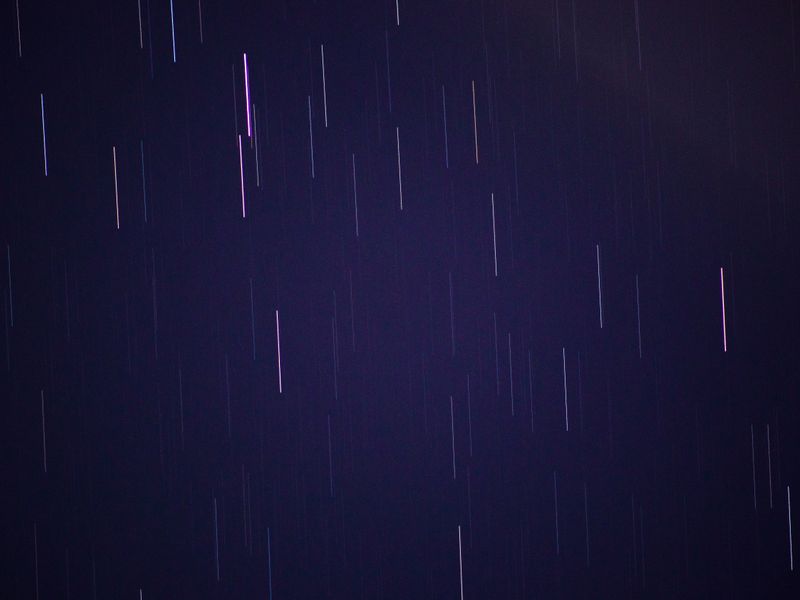
Satellites look like steady, moving points of light
Satellite spotting is easy, free, and a great introduction to astronomy for all ages. All you need is a clear sky, a little timing, and one of the many free tools that predict exactly when and where to look.
Why You Can See Satellites
Satellites don't produce their own light. You see them because they reflect sunlight. That's why the best time to spot them is shortly after sunset or before sunrise: the sky where you are is dark, but satellites high above are still in sunlight. In the middle of the night, many satellites pass through Earth's shadow and become invisible, although in summer months some remain visible for longer.
- Low Earth orbit satellites, a few hundred kilometres up, move quickly and are the easiest to see. A pass usually takes a few minutes.
- The ISS is the brightest satellite, often brighter than any star, because of its large solar panels.
- Satellite "trains": recently launched groups of communication satellites can appear as a line of lights moving together.
Step 1: Use Free Tracking Tools
- Official space station alerts: space agencies offer free services that list upcoming ISS sightings for your location, and can send alerts.
- Satellite tracking websites: sites such as Heavens-Above show visible passes for many satellites, with sky charts showing their path.
- Mobile apps: satellite tracker and sky-map apps use your location to show passes and point you in the right direction.
Set your exact location for accurate predictions. Most tools list the start time, direction, maximum height, and brightness of each pass.
Step 2: Read a Pass Prediction
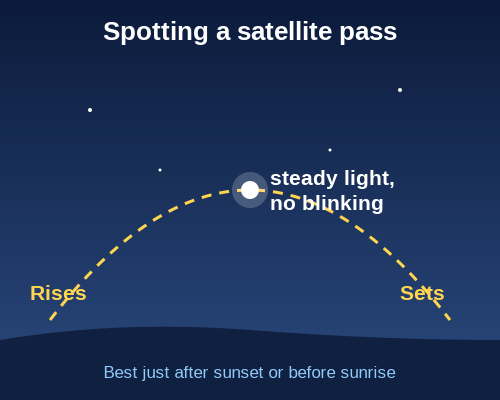
A typical pass lasts only a few minutes
- Start time and direction: when and where the satellite appears, such as "west-north-west".
- Maximum height: given in degrees above the horizon; 90° is directly overhead, and higher passes are easier to see.
- End time and direction: when it disappears or fades into Earth's shadow.
- Brightness (magnitude): lower or negative numbers mean brighter. The ISS often reaches around −3, brighter than any star.
Use your hand to measure the sky
Held at arm's length, a clenched fist covers about 10 degrees of sky. A satellite at 30° height is about three fists above the horizon.
Step 3: Go Out and Spot It
- Go outside a few minutes early and let your eyes adjust to the dark.
- Face the direction where the pass begins, using your phone's compass if needed.
- Look for a steady, non-blinking point of light moving smoothly across the sky.
- Follow it across the sky; you may see it fade suddenly as it enters Earth's shadow.
Step 4: Tell Satellites From Planes and Stars
- Satellites: steady light, silent, smooth and fairly fast movement, no colours.
- Aircraft: flashing red, green, or white lights, and often audible.
- Stars and planets: don't move noticeably over a few minutes.
- Meteors: very fast streaks lasting a second or less.
Step 5: Photograph a Satellite Pass
With a camera or smartphone on a tripod, you can capture the ISS as a bright line across the sky. Use a long exposure of 10 to 30 seconds, set focus to infinity, and start the exposure just before the satellite enters the frame. Many smartphones have a night mode or "pro" mode that allows longer exposures. Including trees, buildings, or landscapes in the frame makes photos more striking.
Share the Experience
Satellite spotting is a wonderful family activity. Children love waving at the space station, knowing astronauts are on board, and checking the live position of the ISS online. Astronomy clubs often hold public viewing nights where members point out satellites, planets, and constellations. Combine satellite watching with general stargazing; our guide on viewing stars at night explains how to find your way around the sky, and our guide on learning about planets helps you spot the bright planets too.
More Things to Spot in the Sky
Once you are comfortable spotting satellites, look out for other moving objects in the night sky. Meteor showers happen on predictable dates each year and can produce dozens of shooting stars an hour under dark skies. Iridium flares, bright flashes from older satellites, used to be popular sights, and today some satellites still produce brief glints as sunlight catches their panels.
You can also watch for rocket launches and spacecraft returning to Earth. Space agencies and launch companies publish schedules, and some launches are visible from hundreds of kilometres away as a bright moving light trailing a glowing plume. Following live streams of launches online, then stepping outside to look for the rocket if you live close enough, is an exciting experience for all ages.
Keeping a simple log of what you see, including the date, time, direction, and how bright each object appeared, helps you notice patterns and improves your observing skills. Some citizen science projects use reports and photos from members of the public to track satellites, meteors, and other events, so your observations could even contribute to real research.
Above all, enjoy the experience. Watching a satellite cross the sky is a quiet reminder of human ingenuity and the busy space above us.
Over time, you may even recognise particular satellites by their brightness, path, and timing, and look forward to regular passes of the space station over your home.
Clear skies and happy spotting.
Final Thoughts
Tracking satellites is simple: use a free app or website to find passes for your location, read the time, direction, and height, and step outside around dusk or dawn to watch a steady point of light glide overhead. With a little practice you'll be spotting the space station and other satellites regularly, a reminder of the busy world just above our heads.