
Online resources make biology accessible to everyone
There are excellent free and low-cost resources available, from university courses and textbooks to interactive simulations. The challenge is choosing reliable ones and learning in a structured way. This guide shows you how.
Step 1: Set Your Goals and Level
- Exam preparation: follow your exam board's syllabus closely and use past papers.
- General interest: choose introductory courses and engaging videos covering the big ideas.
- Career or university preparation: look for structured courses with assessments or certificates.
- Specific topics: such as genetics, marine biology, or human physiology, once you know the basics.
Be honest about your starting level. If your science is rusty, begin with an introductory course before tackling advanced topics.
Step 2: Follow a Logical Topic Order
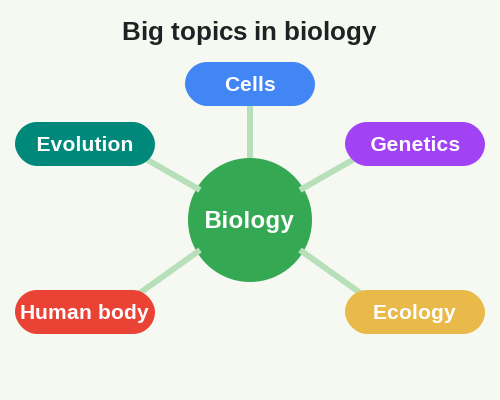
The big topics connect to each other
Biology builds from small to large. A helpful order for beginners is:
- Cells: the basic units of life, their parts, and how they divide.
- Biological molecules: proteins, carbohydrates, fats, and DNA.
- Genetics: how traits are inherited and how DNA works.
- Evolution: how species change over time through natural selection.
- Human biology: body systems such as circulation, digestion, and the nervous system.
- Ecology: how organisms interact with each other and their environment.
Step 3: Choose Trusted Free Resources
- Free course platforms: Khan Academy offers free biology lessons and practice exercises; edX and Coursera host university courses that are often free to audit.
- Open textbooks: OpenStax publishes free, peer-reviewed biology textbooks for school and university levels.
- University open courseware: some universities share full lecture videos and notes free online.
- Educational video channels: many well-known channels explain biology topics clearly with animations; prefer those created by educators or institutions.
- Museums and science organisations: natural history museums and research institutes publish articles, videos, and activities.
Our guide on getting free online certificates explains how to earn recognition for completed courses.
Check your sources
Prefer resources from universities, recognised educational organisations, and science institutions. Be cautious with health or "biology" claims on social media that aren't backed by evidence or experts.
Step 4: Use Simulations and Virtual Labs
Interactive tools help you understand processes that are hard to picture from text alone. Free simulations, such as those from PhET and other educational projects, let you explore topics like natural selection, genetics, and cell processes. Virtual labs let you practise techniques such as microscopy or dissection without equipment. 3D apps of cells, organs, and the human body help with spatial understanding; our guide on studying human anatomy has more tips.
Step 5: Test Yourself and Stay Consistent
- Practice questions: use course quizzes, past exam papers, and online question banks.
- Flashcards: for key terms and processes, ideally with spaced repetition.
- Draw and label diagrams of cells, organs, and cycles from memory.
- Summarise each lesson in your own words.
- Study regularly: short daily sessions beat occasional long ones. A weekly timetable helps; see our guide on creating a study timetable.
Connect Biology to the Real World
Biology is everywhere around you. Observe birds, insects, and plants in your local park and identify them with free nature apps, grow plants and watch how light and water affect them, follow science news about medicine and conservation, and join citizen science projects where volunteers record wildlife or classify images for real research. These activities make biology memorable and show how it connects to everyday life.
Where Biology Can Take You
Biology opens doors to a wide range of careers and further study. Medicine, nursing, pharmacy, dentistry, and veterinary science all build on strong biology knowledge. So do careers in research, biotechnology, environmental science, conservation, agriculture, food science, public health, forensic science, and science teaching or communication.
If you are learning biology online with a future career in mind, look for courses that offer certificates, practical skills such as data analysis or laboratory techniques, and opportunities to connect with others in the field. Many universities offer short online courses that give a taste of degree-level study, which can help you decide which direction suits you best.
Even if you are learning purely for interest, biology changes how you see the world. Understanding how vaccines work, why biodiversity matters, how food is produced, and how your own body responds to exercise and sleep helps you make better everyday decisions and evaluate health and science news with a more critical eye. Keep a list of questions that spark your curiosity, and use them to guide what you learn next.
Learning with others makes a big difference too. Online forums, study groups, and course discussion boards let you ask questions, share resources, and explain ideas to fellow learners. Teaching others is one of the best ways to check and deepen your own understanding, and staying connected with a learning community helps you stay motivated over weeks and months of study.
Set realistic weekly targets, such as completing two lessons and one quiz, and review your progress each weekend. Small, steady steps build a strong foundation, and you will be surprised how much you know after a few months of regular study.
Biology also pairs naturally with chemistry and physics. Understanding basic chemistry, such as atoms, bonds, and reactions, makes topics like photosynthesis, respiration, and DNA much easier to grasp. If you find certain biology topics confusing, a short refresher on the related chemistry often helps everything fall into place. Many free platforms offer introductory chemistry alongside biology, so you can build both together.
Final Thoughts
Learning biology online is very achievable: set clear goals, follow a logical order from cells to ecosystems, use trusted free courses and open textbooks, explore simulations and virtual labs, and test yourself regularly. Add real-world observation, and you'll build a deep, lasting understanding of the living world.