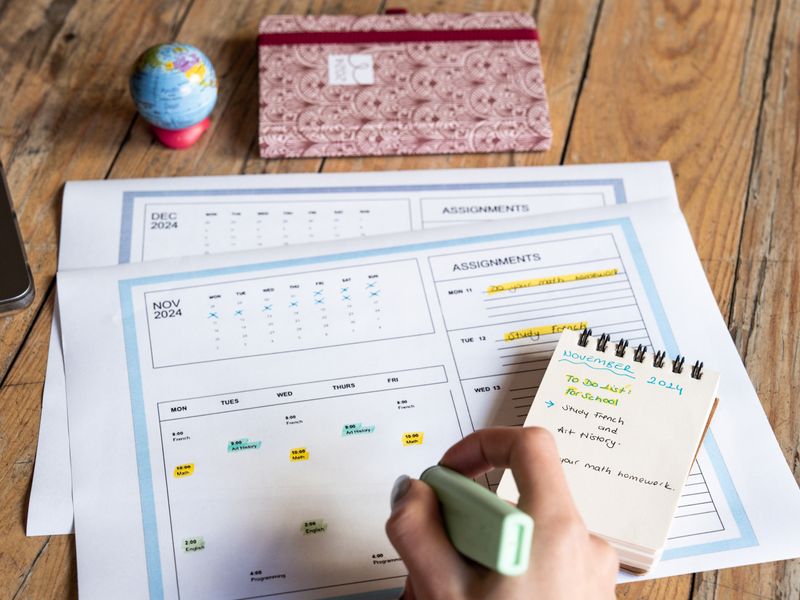
Person planning tasks with a calendar and notepad on a wooden table
The problem is that many timetables are too ambitious and get abandoned within a week. This guide shows you how to build one that fits your real life and still gets results.
Step-by-Step: Building Your Timetable
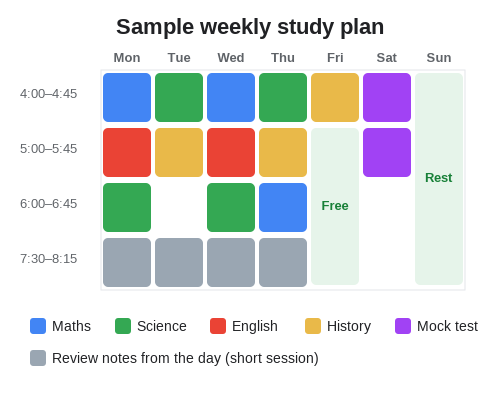
A balanced week with built-in rest
1
List Subjects, Topics, and Deadlines
Write down every subject, the topics within each, and your exam or assignment dates. Mark the topics you find hardest. This list is your map; the timetable is how you travel through it.
2
Map Your Fixed Commitments
Block out classes, travel, work, meals, family time, exercise, and sleep. What's left is the time you genuinely have for study. Being honest here is what makes the plan work.
3
Choose Realistic Study Blocks
Most people focus best in sessions of 25 to 50 minutes, followed by a short break. Two to four focused sessions on a school day is realistic for many students; more is possible on weekends or during exam season.
4
Give Harder Subjects Your Best Time
Put difficult topics at the time of day when you feel sharpest. For many people that's earlier in the day, but notice your own energy patterns. Save lighter tasks, like reviewing flashcards, for when you're more tired.
5
Mix Subjects and Schedule Reviews
Rotating between subjects through the week keeps everything fresh. Research on learning shows that revisiting material after a few days (spaced practice) and testing yourself (retrieval practice) help you remember far more than rereading notes once.
6
Plan Specific Tasks, Not Just Subjects
"Biology" is vague. "Biology: answer past questions on cell structure and check answers" tells you exactly what to do. Good task types include:
- Answering practice or past exam questions
- Making or testing yourself with flashcards
- Summarising a chapter from memory
- Explaining a topic aloud as if teaching someone
7
Protect Rest and Buffer Time
Include at least one lighter day each week and a few empty "buffer" slots to catch up when things go wrong. A plan with no room for life will break quickly.
Make Each Session Count
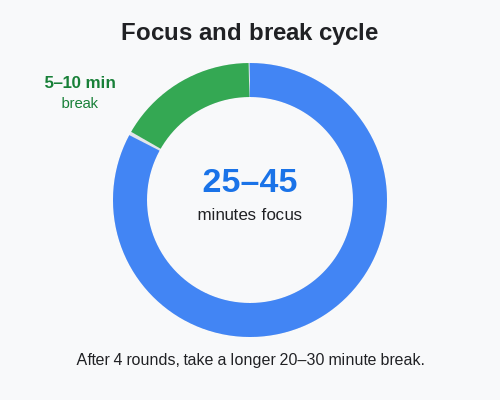
Short focus blocks with regular breaks
- Put your phone in another room or switch on focus mode
- Have everything you need ready before you start
- Use breaks to move, drink water, or step outside, not to scroll
- Write down one goal at the start of each session
Review and Adjust Weekly
At the end of each week, spend ten minutes asking: What did I finish? What did I skip, and why? Which topics still feel weak? Then adjust next week's plan. A timetable is a tool, not a contract, and small changes keep it realistic.
Common Mistakes
- Planning eight-hour study days that you'll never keep
- Spending more time decorating the timetable than studying
- Only rereading notes instead of testing yourself
- Cutting sleep to study more, which hurts memory and concentration
- Giving up after one missed day instead of simply restarting
How to Divide Time Between Subjects
Not every subject needs equal time. A simple method is to rate your confidence in each subject from 1 (very weak) to 5 (very strong), then give weaker subjects more sessions.
Worked example
You have 16 study sessions available this week and four subjects:
• Maths: confidence 2 → 5 sessions
• Chemistry: confidence 2 → 5 sessions
• English: confidence 3 → 4 sessions
• History: confidence 4 → 2 sessions
Weaker subjects get more practice, but every subject is still touched each week so nothing is forgotten.
Also consider how much each exam is worth and how soon it is. An exam next week deserves more time now than one in two months, even if it's in a stronger subject.
Term-Time vs. Exam-Season Timetables
During term
- Shorter daily sessions, often 1–2 hours
- Focus on homework and reviewing that day's lessons
- One weekly session to revisit older topics
- Plenty of time for rest and activities
Before exams
- More sessions, built around exam dates
- Heavy use of past papers and timed practice
- Regular review of weakest topics
- Still protect sleep, meals, and short daily breaks
Simple Tools to Build Your Timetable
- Paper planner or printed grid: easy to see on your wall and satisfying to tick off.
- Digital calendar: add study blocks as recurring events with reminders.
- Spreadsheet: useful for tracking topics, confidence ratings, and completed sessions.
- Timer: any phone or kitchen timer works for focused study blocks.
Whichever tool you choose, keep it simple. The timetable should take minutes to update, not hours.
Balance Study With Rest and Wellbeing
A timetable that leaves no room for rest rarely lasts. Your brain consolidates learning during breaks and sleep, so protecting them is part of studying well, not a distraction from it.
- Schedule sleep: aim for a consistent bedtime and seven to nine hours. Late-night cramming usually costs more than it gains.
- Plan short breaks: five to ten minutes every hour helps you stay focused. Stand up, stretch, and get water.
- Include exercise: even a short walk improves concentration and mood.
- Keep one free evening or half-day a week: time with friends and hobbies prevents burnout.
- Watch for warning signs: constant tiredness, trouble sleeping, or feeling overwhelmed are signs to slow down and talk to a teacher, family member, or counsellor.
A balanced timetable is easier to follow, and you'll remember more of what you study.
Final Thoughts
The best study timetable is one you'll actually follow. Be honest about your time, plan specific tasks in short focused blocks, mix in regular review, and adjust every week. Consistent, moderate effort beats occasional all-night cramming every time.