
A student deeply engaged in study at a library desk surrounded by bookshelves and natural
This guide shows you where to look first, how to judge what you find, and how to turn a study guide into real exam-ready knowledge.
Start With Your Syllabus
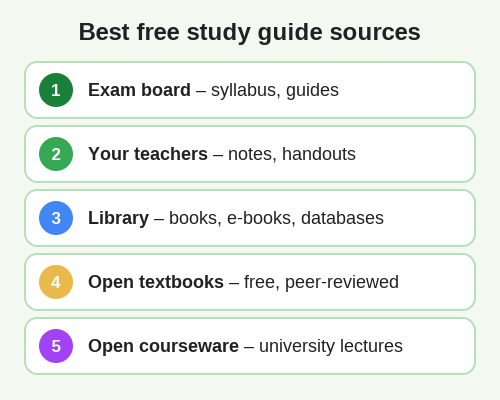
Start with official and trusted sources
Before looking for any study guide, get the official syllabus or specification for your course. It lists every topic you can be assessed on and often the exact skills expected. Download it from your exam board's or institution's website, or ask your teacher. Use it as a checklist: every resource you use should map to something on it.
Why this matters
Syllabuses change. A guide written for a different exam board, country, or older version of your course may skip topics you need or include ones you don't. Always check the course name and year.
Where to Find Free Study Guides
1
Official Exam Board or Institution Websites
Many exam boards publish free specifications, teacher guides, sample questions, and examiner reports that explain common mistakes. Examiner reports are one of the most underused free resources available.
2
Your Teachers and Course Pages
Teachers often have revision packs, topic summaries, and practice questions they're happy to share. College and university students should check their course's online learning platform for lecture slides and reading lists.
3
Public and School Libraries
Libraries lend revision guides and textbooks, and many give members free online access to e-books, academic databases, and learning platforms. Ask a librarian what digital resources your membership includes.
4
Open Textbooks
Open educational resources are free, legally shareable learning materials. OpenStax, for example, publishes free, peer-reviewed textbooks in subjects like biology, physics, economics, and psychology, mainly at college level.
5
University Open Courseware and Learning Sites
Some universities, such as MIT through OpenCourseWare, share lecture notes, problem sets, and exams for free. Nonprofit sites like Khan Academy offer free lessons and practice exercises across many school subjects.
How to Check a Guide Is Reliable
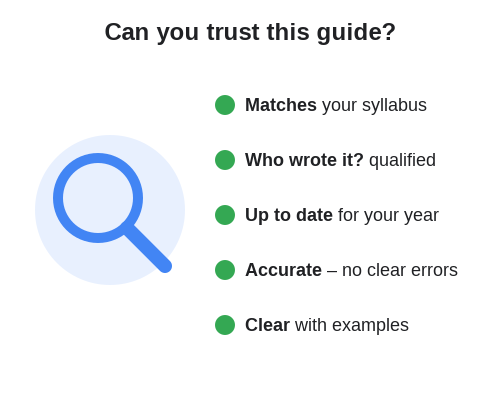
Five quick quality checks
- Does it match your syllabus, exam board, and level?
- Who created it? Teachers, universities, and exam boards are more reliable than anonymous uploads.
- Is it current? Check the date, especially for subjects like law, technology, or economics.
- Is it accurate? If something contradicts your textbook, check with your teacher.
- Is it clear, with examples and practice questions, not just lists of facts?
Avoid illegal copies
Be careful with sites offering free downloads of paid textbooks and guides. They're often pirated, may contain malware, and can put your device and data at risk. Stick to official and openly licensed sources.
How to Use Study Guides Effectively
- Don't just read and highlight. After each section, close the guide and write or say what you remember.
- Turn content into questions and test yourself a few days later.
- Make your own condensed notes or mind maps from the guide.
- Pair guides with practice questions and past exam papers to apply what you've learned.
- Use one main guide per subject rather than jumping between many.
What to Look For, Subject by Subject
- Maths and physics: guides with fully worked examples followed by graded practice questions and answers. Explanations alone aren't enough; you learn by solving problems.
- Biology and chemistry: clear diagrams, key definitions, and questions on practical experiments, which often appear in exams.
- History and social sciences: timelines, key debates, source analysis practice, and sample essay plans.
- English and literature: theme and character summaries, key quotations, and example essays with examiner comments.
- Languages: vocabulary lists by topic, grammar tables, and listening practice with audio and transcripts.
Make Your Own Study Guide
Sometimes the best study guide is the one you build yourself. The act of creating it is powerful revision.
1
Copy the Syllabus Headings
Use each syllabus topic as a heading in a document or notebook. This guarantees full coverage.
2
Summarise Each Topic on One Page
Use your notes, textbook, and trusted free resources. Include key definitions, a diagram or example, and common mistakes.
3
Add Three Practice Questions per Topic
Take them from past papers or textbooks, and note the page or source of the answers so you can check yourself.
4
Rate Your Confidence
Mark each topic red, amber, or green, then focus your revision on the red and amber ones. Update the colours as you improve.
Share Resources Through Study Groups
A small study group of three to five classmates can split the work: each person prepares a one-page summary for different topics, then everyone checks and shares. You get a complete guide in less time, and explaining your topic to others deepens your own understanding. Keep sessions focused with a clear agenda and time limit.
Stay Legal and Safe When Downloading
Use guides shared by official exam boards, schools, libraries, and educational organisations. Avoid sites offering pirated textbooks or paid materials for free; they break copyright law and often contain malware or pop-up scams. Never enter payment details or install unknown software to "unlock" a free guide. If a resource seems too good to be true, check with your teacher or librarian before downloading it.
Finally, remember that study guides are a supplement to your class notes and textbooks, not a replacement for them. Use them to check understanding, practise questions, and fill gaps, but always return to your syllabus to make sure you are covering exactly what your exam requires. Ask your teacher if you are unsure whether a guide is suitable for your course.
Final Thoughts
The best free study guides come from official and trusted sources and match your syllabus exactly. Start with your exam board, teachers, and library, check quality carefully, and use guides actively by testing yourself. Good resources plus good study habits are a powerful combination.