
Group of graduates in gowns celebrating outdoors with a building backdrop
The students who win most often aren't always the most gifted. They're usually the ones who apply early, apply widely, and tailor each application carefully. Here's how to do exactly that.
Understand the Types of Scholarships
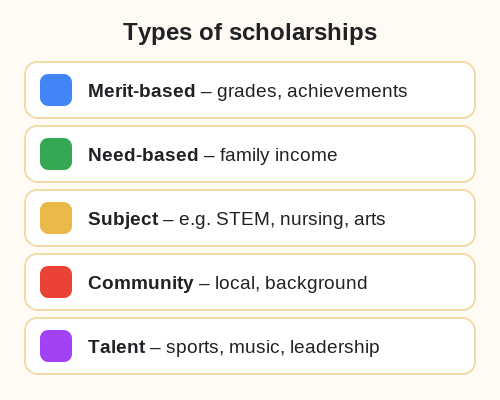
There's more than one way to qualify
- Merit-based: awarded for grades, test results, or achievements
- Need-based: based on your family's financial situation
- Subject-specific: for students in fields like science, nursing, teaching, or the arts
- Community or identity-based: for students from a particular region, background, or group
- Talent-based: for sports, music, leadership, or community service
Scholarships vs. loans
Scholarships and grants generally don't need to be repaid, while loans do. Read the terms of every award; some come with conditions such as maintaining certain grades or studying a particular subject.
Where to Find Scholarships
- Your chosen college or university: check its financial aid or scholarships page; many awards are automatic or need only a short form.
- Your school counsellor or careers office: they often know about local awards.
- Government programmes: search your country's official student finance or education ministry website.
- Local organisations: community groups, religious organisations, businesses, and unions often fund local students.
- Professional associations: many fields offer awards to encourage new students.
- Your parents' employers: some companies offer scholarships for employees' children.
Smaller, local scholarships are often less competitive than big national ones, and several small awards add up quickly.
How to Apply Step by Step
1
Make a Tracker
Use a spreadsheet with the scholarship name, amount, eligibility, deadline, required documents, and status. Sort it by deadline so nothing slips through.
2
Read the Criteria Closely
Only apply where you clearly meet the requirements. Then look for what the funder cares about, whether it's leadership, community impact, or a commitment to a career. Your application should speak directly to that.
3
Prepare Your Documents Once
Many applications ask for the same things: transcripts, a CV or list of activities, proof of income, ID, and references. Collect them early in a single folder so each new application is faster.
4
Write a Tailored Essay
You can reuse a strong core story, but adapt it to each prompt. A good scholarship essay:
- Answers the exact question asked
- Uses a specific example rather than general statements
- Explains your goals and how the award will help
- Stays within the word limit
5
Ask for References Early
Give referees at least two to three weeks, along with the deadline, a description of the scholarship, and a summary of your achievements.
6
Proofread and Submit Early
Small errors suggest carelessness. Proofread, ask someone else to check, and submit a few days before the deadline. Keep a copy of everything you send.
How to Avoid Scholarship Scams
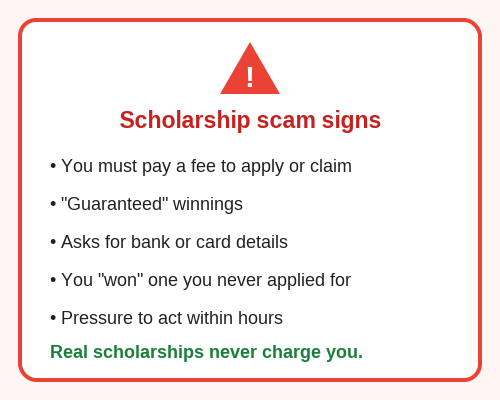
Know the warning signs
- Asks you to pay an application, processing, or "release" fee
- Guarantees that you'll win
- Asks for bank account or card details to "deposit" your award
- Says you've won something you never applied for
- Pressures you to respond immediately
If in doubt, search the organisation's name with the word "scam," and check with your school or college financial aid office.
Writing a Scholarship Essay: Structure and Example
Most scholarship essays ask some version of "Tell us about yourself and why you deserve this award." A clear structure keeps you focused:
- Hook (1–2 sentences): a specific moment or challenge that shaped your goals.
- Your story (1–2 paragraphs): what you did, what obstacles you faced, and what you achieved.
- Your goals (1 paragraph): what you plan to study and what you want to do afterwards.
- The link (1 paragraph): how this specific scholarship helps you get there, and how you'll give back.
Example opening
"At fifteen, I started tutoring my younger cousins in maths at our kitchen table because my aunt couldn't afford lessons. Three years later, that table has become a weekly study group of eight students, and it's why I want to train as a secondary school maths teacher."
Notice how this example is specific, shows initiative and impact, and connects directly to a goal. That's what selection panels remember.
Writing About Financial Need
For need-based awards, you may be asked to explain your financial situation. Keep it factual and respectful of your own privacy:
- Describe your circumstances clearly and briefly, such as household size, income situation, or unexpected costs.
- Explain how financial pressure affects your studies, for example working long hours alongside school.
- Focus on how you've responded and what the award would make possible.
- Make sure figures match any official documents you submit.
What to Put in Your Scholarship Tracker
A simple spreadsheet saves hours and prevents missed deadlines. Useful columns include:
- Scholarship name and website link
- Amount and whether it's one-off or renewable
- Eligibility requirements
- Deadline (with time zone)
- Documents needed: essay, transcript, references, proof of income
- Status: researching, drafting, submitted, result
- Notes, such as essay prompt and word limit
After the Results
- If you win: accept formally by the deadline, send a thank-you letter to the funder, and tell your college's financial aid office, since some awards affect other aid.
- Check the conditions: some scholarships require minimum grades, full-time study, or reports to stay renewable.
- If you don't win: it's normal; competition is high. Ask for feedback if offered, improve your essay, and keep applying. Many winners applied to dozens of awards.
If You Aren't Successful
Scholarships are competitive, so rejection is common. Ask for feedback where possible, improve your essays, and apply again next cycle or for smaller awards with fewer applicants.
Final Thoughts
Winning scholarships is partly a numbers game and partly about care. Apply to many awards you genuinely qualify for, tailor each application, and stay organised with deadlines. Even one or two successful applications can make a real difference to the cost of your education.