
Professional man in turtleneck at office desk during an interview
This guide covers what to research, how to answer the most common questions, what to ask at the end, and how to follow up.
Step 1: Research the Company and the Role
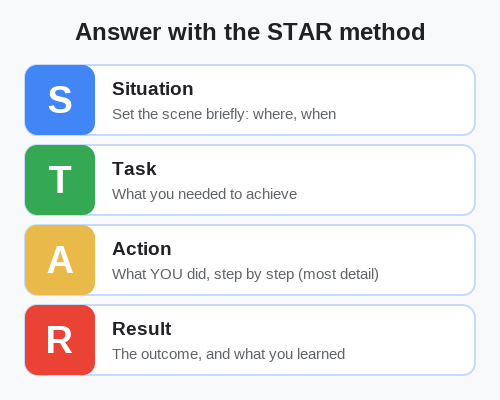
A simple structure for strong answers
- Reread the job advert and list the top five skills or responsibilities it emphasises.
- Study the company website: what they do, who their customers are, their values, and any recent news.
- Look up your interviewers on LinkedIn if you know their names, to understand their roles.
- Understand the format: phone, video, in person, a panel, a test, or a presentation.
Your goal is to be able to explain in one or two sentences why this company and this role interest you.
Step 2: Prepare Stories With the STAR Method
Many questions start with "Tell me about a time when..." These are behavioural questions, and the STAR method keeps your answers focused: Situation, Task, Action, Result. Spend most of your answer on the Action, what you specifically did, and finish with a clear result.
Prepare five or six stories that can be adapted to different questions, covering:
- Solving a difficult problem
- Working in a team, including a disagreement
- Handling pressure or a tight deadline
- Making a mistake and what you learned
- Taking initiative or leading something
- Dealing with a difficult customer or person
Step 3: Practise Common Questions
1
"Tell me about yourself."
Keep it to about one to two minutes: your current situation, relevant experience or studies, and why you're interested in this role. It's a professional summary, not your life story.
2
"Why do you want to work here?"
Mention something specific from your research, such as a product, value, or project, and connect it to your own interests and skills.
3
"What are your strengths?"
Pick two or three strengths that match the job, and back each one with a short example.
4
"What is your biggest weakness?"
Choose a real but manageable weakness and explain what you're doing to improve it. For example: "I used to find it hard to delegate, so I now agree clear task lists with my team at the start of each project."
5
"Where do you see yourself in five years?"
Show ambition that fits the role: growing your skills, taking on more responsibility, and contributing to the team.
Practise out loud
Answers that sound fine in your head often come out messy. Practise aloud, record yourself, or ask a friend to run a mock interview. Aim to sound prepared, not memorised.
Step 4: Prepare Questions to Ask
Always have two or three questions ready. Good examples:
- "What does success look like in this role after the first three months?"
- "What are the biggest challenges the team is facing right now?"
- "How would you describe the team's way of working?"
- "What are the next steps in the process?"
Step 5: Get the Day Right
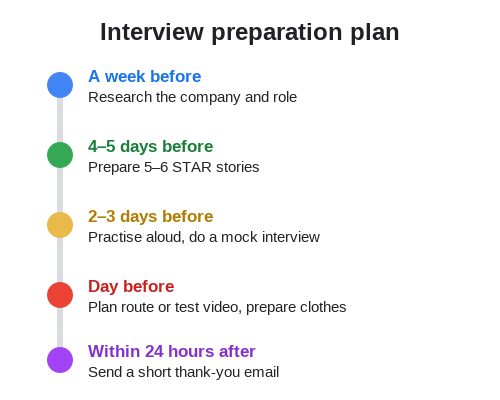
Spread preparation over a week
- In person: plan your route, aim to arrive 10 minutes early, and bring copies of your CV.
- Video: test your camera, microphone, and internet; choose a quiet spot with good light; close other apps.
- Dress: match or slightly exceed the company's usual dress code.
- Body language: sit upright, make natural eye contact, and listen fully before answering.
- If you don't know: it's fine to pause, ask for clarification, or explain how you'd find the answer.
Step 6: Follow Up
Within 24 hours, send a short thank-you email. Thank them for their time, mention one thing you enjoyed discussing, and briefly restate your interest. If you don't get the job, it's reasonable to ask politely for feedback; it will help with the next one.
A Full STAR Answer Example
Question: "Tell me about a time you dealt with a difficult customer."
Example answer
Situation: "At my weekend job in a phone shop, a customer came in angry because his repaired phone had stopped working again after two days."
Task: "I needed to calm the situation and find a fair solution without breaking store policy."
Action: "I listened without interrupting, apologised for the inconvenience, and checked the repair record. It was still under the repair warranty, so I booked it as a priority job and lent him a spare handset from our loan stock so he wasn't left without a phone."
Result: "He left calm, the phone was fixed the next day, and he later left a positive review mentioning me by name. I learned that most angry customers mainly want to feel heard and see a clear plan."
The answer takes about 90 seconds to say, focuses on the candidate's own actions, and ends with a result and a lesson.
Different Interview Formats
- Phone screening: short and often with a recruiter. Have your CV in front of you and be ready to explain your interest and salary expectations.
- Video interview: look at the camera when speaking, keep notes off-screen to a few keywords, and have a backup plan if your connection drops.
- Panel interview: make eye contact with the person who asked the question, then include the others as you answer.
- Pre-recorded video: you answer on-screen prompts within a time limit. Practise with a timer.
- Assessment or task: you may get a test, case study, or presentation. Ask in advance what to expect and how long you'll have.
Common Interview Mistakes
- Speaking negatively about a previous employer or colleague
- Giving vague answers without real examples
- Not knowing basic facts about the company
- Talking for too long; most answers should take one to two minutes
- Saying "no" when asked if you have questions
- Forgetting to silence your phone
Final Thoughts
Interview success comes from preparation, not luck. Research the role, prepare real stories, practise out loud, and treat the interview as a two-way conversation. Every interview you do, whatever the outcome, makes the next one easier.