
Audience attentively watching a presentation in a conference setting, with stage lights
Good speakers are rarely born that way. They prepare well, practise in smart ways, and learn to work with their nerves instead of against them. Here's how you can do the same.
Start With a Clear Structure
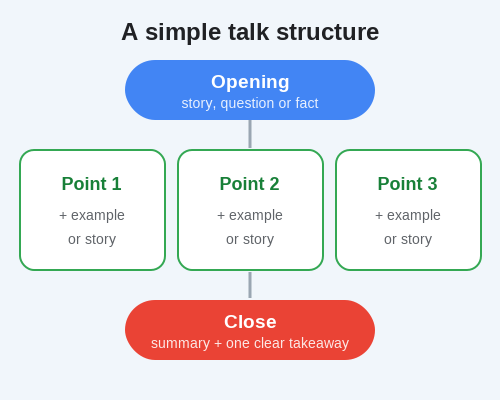
Most good talks follow a simple shape
A clear structure helps your audience follow you, and helps you remember what comes next.
- Opening: grab attention with a short story, a surprising fact, or a question. Then say what the talk is about.
- Body: two or three main points, each with an example, story, or piece of evidence.
- Close: summarise your points and leave one clear takeaway or call to action.
The one-sentence test
Before preparing slides or notes, write down the single message you want people to remember. If you can't say it in one sentence, your talk probably needs more focus.
Practise the Right Way
1
Use Key-Point Notes, Not a Script
Reading word for word sounds flat and makes you lose your place. Write short prompts for each section instead. You'll sound more natural and can still glance down if you need to.
2
Rehearse Out Loud and Time It
Practise standing up, saying the words aloud. Time yourself; most talks run longer in real life than people expect. Plan to finish slightly under your time limit.
3
Record Yourself
Watching a recording is uncomfortable but powerful. Look for filler words ("um," "like"), speaking too fast, and habits like swaying or touching your face. Fix one thing at a time.
4
Practise the Opening Most
Nerves are usually strongest in the first minute. Knowing your opening very well gives you a confident start, and confidence tends to build from there.
How to Handle Nerves
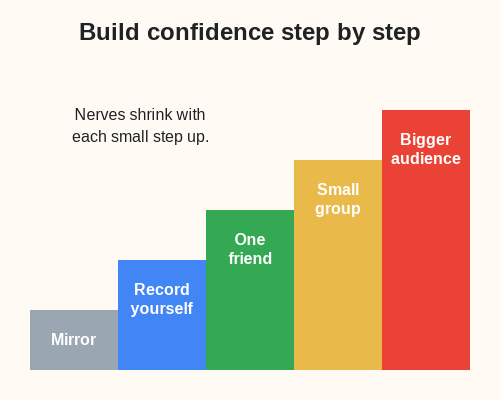
Build up to bigger audiences gradually
- Slow your breathing: breathe in for four counts and out for six, a few times before you start.
- Reframe the feeling: telling yourself "I'm excited" instead of "I'm nervous" can help you feel more energised.
- Focus on the audience: you're there to help them understand something, not to be judged.
- Find friendly faces: speak to a few people who look engaged.
- Practise in steps: mirror, recording, one friend, a small group, then larger audiences.
If fear of speaking is severe and stops you from doing things you need to do, talking to a counsellor or joining a supportive practice group can help a lot.
Use Your Voice and Body Well
- Pace: slow down, especially at important points. Pauses feel long to you but natural to listeners.
- Volume: speak a little louder than feels normal so people at the back can hear.
- Eye contact: look at different parts of the room, holding each person's gaze for a moment.
- Posture: stand with your weight even, shoulders relaxed, and hands free to gesture naturally.
- Slides: keep them simple, with few words and large visuals; they support you, not replace you.
Keep Improving
Look for low-pressure chances to speak: asking a question in class, presenting in a team meeting, or joining a public speaking club such as Toastmasters, which exists in many countries. After each talk, ask one person for one thing you did well and one thing to improve.
Example: A 5-Minute Talk Outline
Here's how a short talk titled "Why Every Student Should Learn to Budget" might be planned. Roughly 130–150 spoken words make up one minute, so five minutes is about 650–750 words.
1
Opening (about 45 seconds)
"Raise your hand if you've ever reached the end of the month wondering where your money went." Pause. Then state the message: "A simple budget gives you control, and it takes 20 minutes a month."
2
Three Points (about 3½ minutes)
- Point 1: Small spending adds up, with one real example in numbers.
- Point 2: A budget reduces stress, with a short personal story.
- Point 3: It's easy to start, showing three steps.
3
Close (about 45 seconds)
Summarise the three points in one sentence each, then end with a clear call to action: "Tonight, write down every expense from the last three days. That's your first step."
Handling Questions From the Audience
- Listen to the whole question before you start answering.
- Repeat or rephrase it so everyone hears it and you get a moment to think.
- Answer briefly and check if it helped: "Does that answer your question?"
- If you don't know, say so honestly and offer to follow up later.
- Prepare for likely questions by listing three or four in advance.
Speaking in Online Meetings and Video Calls
- Place your camera at eye level and look into it when making key points
- Use a headset or quiet room for clear audio, which matters more than video quality
- Speak slightly slower and pause more, since there can be small delays
- Share slides only when needed, then stop sharing so people can see you
- Check in with the audience more often, as you can't read the room as easily
Use Slides and Visual Aids Well
Slides should support you, not replace you. Keep each slide to one idea, use large text and clear images, and avoid reading your slides aloud. A good rule is no more than a few words or one simple chart per slide. Test the equipment before you speak, bring a copy of your presentation on a USB stick or in your email, and be ready to continue without slides if the technology fails. Your audience came to hear you.
Final Thoughts
Confident speaking is a skill, not a personality trait. Keep your message simple and well structured, practise out loud, accept a few nerves as normal, and take every chance to speak. Each small talk you give makes the next one easier.