
Overhead view of laptops, charts, and reports used for data analysis on a desk
The good news is that you can learn much of it for free and practise with real results. This guide explains the core skills, where to learn them, and how to gain experience before anyone hires you.
Understand the Big Picture First
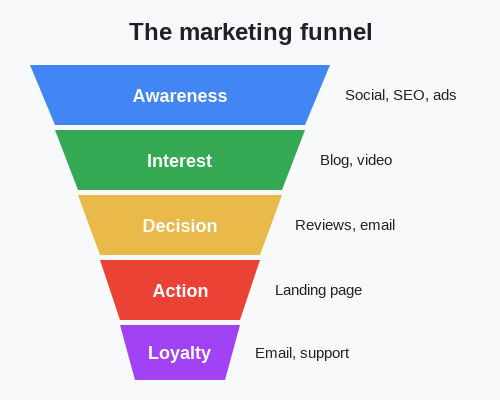
How people go from stranger to customer
Before diving into tactics, learn the idea of the marketing funnel. People usually move through stages: first they become aware of a brand, then they get interested, compare options, take action, and hopefully return. Each digital channel plays a different role in that journey. Understanding this helps you see why a blog post, an advert, and an email each matter.
The Core Skills
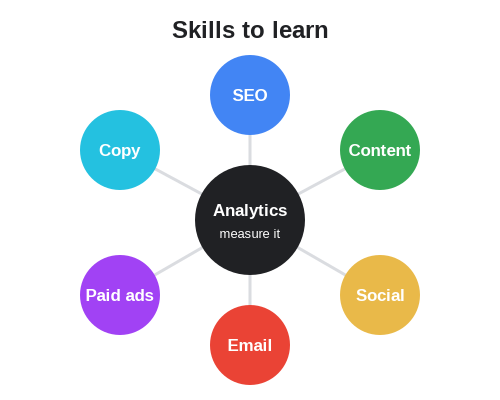
Analytics connects every channel
- SEO (search engine optimisation): helping pages appear in search results for the right queries
- Content marketing: creating useful articles, videos, and guides that attract and educate
- Social media marketing: building an audience and community on social platforms
- Email marketing: keeping in touch with subscribers and customers
- Paid advertising: running search and social ads with a budget
- Copywriting: writing clear, persuasive words for pages, ads, and emails
- Analytics: measuring what works using data, so decisions aren't guesses
Where to Learn for Free
- Google Skillshop: free training and certifications for Google Ads and Google Analytics
- HubSpot Academy: free courses with certificates in inbound, content, email, and social media marketing
- Meta Blueprint: free lessons on advertising across Facebook and Instagram
- Official search engine guides: Google Search Central publishes a free SEO starter guide
- University platforms: introductory marketing courses you can audit for free
Good to know
Marketing platforms change quickly. Prefer recent courses and official documentation, and be cautious of older tutorials that describe features which may no longer exist.
Get Real Experience: Step by Step
1
Start Your Own Small Project
Create a simple blog, a social media page about a hobby, or a newsletter. It gives you a safe place to practise SEO, content, and social media, and to see real numbers move.
2
Set Up Analytics
Install a free analytics tool on your project. Learn to read traffic sources, popular pages, and conversions. Being comfortable with data makes you stand out.
3
Help a Local Business or Charity
Offer to help a small business, club, or nonprofit with their social media, Google Business Profile, or email newsletter. Agree on clear goals and get permission to share the results.
4
Write Up Case Studies
For each project, write a short case study: the goal, what you did, the results (with numbers where possible), and what you'd do differently. This is what employers want to see.
5
Pick a Specialism
After a few months, choose the area you enjoy most, such as SEO, paid ads, or content, and go deeper. Specialists often find work faster than generalists.
Common Beginner Mistakes
- Collecting certificates without doing any real projects
- Chasing likes and followers instead of meaningful results such as sign-ups or sales
- Spending money on ads before understanding the audience
- Trying to be on every platform at once
- Ignoring the basics of good writing
Key Metrics Every Beginner Should Understand
Marketing decisions are based on numbers. These are the ones you'll see most often, with simple examples:
- Click-through rate (CTR): clicks ÷ impressions × 100. If an ad is shown 2,000 times and gets 50 clicks, the CTR is 2.5%.
- Conversion rate: conversions ÷ visitors × 100. If 1,000 people visit a page and 30 sign up, the conversion rate is 3%.
- Cost per click (CPC): ad spend ÷ clicks. Spending 100 on 250 clicks means a CPC of 0.40.
- Cost per acquisition (CPA): ad spend ÷ customers gained. Spending 300 to win 15 customers means a CPA of 20.
- Email open and click rates: the share of recipients who open an email, and who click a link in it.
- Return on ad spend (ROAS): revenue ÷ ad spend. Earning 900 from 300 of ads gives a ROAS of 3, or 3:1.
Context matters
There's no universal "good" number. Typical rates vary hugely by industry, platform, and audience. Compare your results with your own past performance and aim to improve over time.
A 30-Day Starter Project
Here's a structured way to gain hands-on experience in one month using a small blog or newsletter about a topic you know well:
1
Days 1–7: Research and Set Up
Define your audience in one sentence. List 20 questions they search for, using search suggestions and forums. Set up a free blog or newsletter platform and connect analytics.
2
Days 8–15: Create Helpful Content
Publish three genuinely useful posts that answer specific questions. Apply basic SEO: a clear title, headings, a short meta description, and helpful internal links.
3
Days 16–23: Distribute
Share each post where your audience spends time, adapting the message for each platform. Add an email sign-up form and offer a simple checklist as a reason to subscribe.
4
Days 24–30: Measure and Report
Review visitors, top traffic sources, time on page, and sign-ups. Write a one-page report: what worked, what didn't, and what you'd test next. That report becomes your first case study.
Career Paths in Digital Marketing
- SEO specialist: improves rankings through content, technical fixes, and links.
- Content marketer: plans and creates articles, videos, and guides.
- Social media manager: runs brand accounts, community, and campaigns.
- Paid media (PPC) specialist: manages search and social advertising budgets.
- Email marketing specialist: builds lists, campaigns, and automated sequences.
- Marketing analyst: measures performance and turns data into recommendations.
Entry-level roles often have titles like "marketing assistant," "marketing coordinator," or "digital marketing executive," and involve a mix of these tasks.
Final Thoughts
Digital marketing rewards people who test, measure, and learn. Take a free course to understand the basics, then practise on a real project as soon as possible. A few honest case studies with real numbers will do more for your career than a long list of certificates.