Top view of a desk with resume, coffee cup, and laptop on a wooden surface
Whether you're writing your first resume or updating an old one, these steps will help you produce one that's easy to read and hard to ignore. (In many countries a resume is called a CV; the advice is the same.)
Use a Clear, Simple Layout
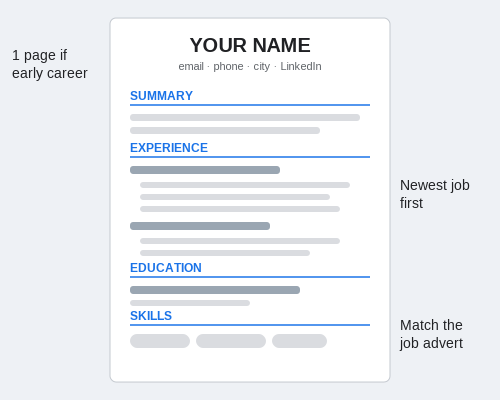
A clean, easy-to-scan layout
- Length: one page is usually enough for students and early-career roles; two pages is common with more experience.
- Font: a clean font like Arial, Calibri, or similar, around 10–12 point.
- Order: newest experience first (reverse chronological order).
- Design: plenty of white space, clear headings, and consistent formatting.
- File type: PDF unless the employer asks for something else; name it "Firstname-Lastname-Resume.pdf".
Applicant tracking systems
Many employers use software to scan resumes. Simple layouts with standard headings like "Experience" and "Education" are read most reliably. Avoid putting key information inside images, text boxes, or complex tables.
Section by Section
1
Contact Details
Name, phone number, a professional email address, your city or region, and a LinkedIn or portfolio link if you have one. You usually don't need your full home address, date of birth, or a photo, although expectations vary by country.
2
A Short Summary
Two or three lines at the top that say who you are, what you're good at, and what you're looking for. For example:
- "Business student with retail and customer service experience, strong at problem-solving under pressure, seeking a marketing internship."
3
Experience With Achievements
List your job title, employer, location, and dates, then three to five bullet points. Start each bullet with an action verb (organised, built, improved, trained, reduced) and include results or numbers where you can. Part-time jobs, volunteering, internships, and serious projects all count.
4
Education
Include your qualification, institution, and dates. Add relevant modules, projects, or strong results if you're a student or recent graduate. As you gain experience, this section becomes shorter and moves lower.
5
Skills
List specific, relevant skills such as software, languages, or technical abilities, ideally ones mentioned in the job advert. Avoid vague claims like "hard-working" here; prove those through your experience bullets instead.
Write Bullet Points That Show Results
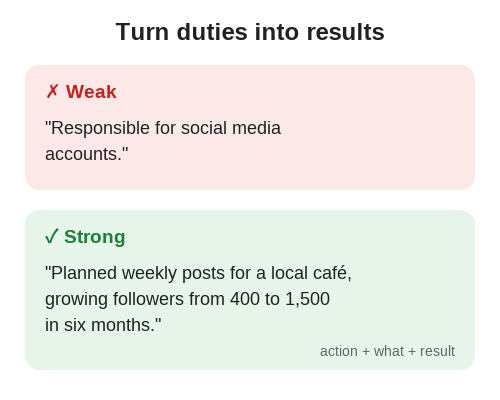
Action + task + result
- Weak: "Served customers." Strong: "Served 80+ customers per shift while keeping waiting times under five minutes."
- Weak: "Helped with events." Strong: "Coordinated volunteers for a 200-person charity event."
- Weak: "Did data entry." Strong: "Cleaned and updated 1,200 customer records, reducing returned mail."
Only use numbers you can honestly explain in an interview.
Tailor It for Every Job
Read the job advert and highlight the skills and responsibilities it mentions most. Then adjust your summary, reorder your bullet points, and use the same key terms where they truthfully describe your experience. A tailored resume almost always beats a generic one sent to fifty employers.
Mistakes to Avoid
- Spelling and grammar errors; ask someone else to proofread
- Long paragraphs that are hard to scan
- An unprofessional email address
- Unexplained gaps; a short, honest note like "Career break: caring for family member" is fine
- Exaggerating or inventing experience, which can cost you the job later
A Complete Example Entry
Here's how one experience entry might look on a student's resume:
Example
Sales Assistant — City Books, Manchester | June 2024 – Present
• Serve 60+ customers per shift, recommending titles that increased add-on sales of bookmarks and gift cards
• Reorganised the children's section by age group, cutting time spent searching for stock
• Trained three new part-time staff on the till system and returns process
• Trusted to open and close the store independently on weekends
Each bullet starts with a strong verb, shows responsibility, and hints at results, all in a few lines.
Useful Action Verbs
Leadership
- Led, coordinated, supervised
- Trained, mentored, organised
Results
- Increased, reduced, saved
- Achieved, improved, grew
Doing and making
- Built, designed, created
- Analysed, researched, resolved
Writing a Resume With Little or No Experience
Everyone starts somewhere. If you haven't had a formal job yet, you can still build a strong one-page resume:
- Lead with education: include relevant subjects, projects, and achievements.
- Add a "Projects" section: school assignments, personal websites, events you organised, or anything you built.
- Include volunteering and informal work: babysitting, helping in a family business, tutoring, and community work all show responsibility.
- Show skills with proof: instead of "good communicator," write "Presented project findings to a class of 30 and answered questions."
- Mention awards and activities: sports, clubs, competitions, and leadership roles.
Quick Cover Letter Tips
- Address it to a named person if you can find one
- Open by naming the role and one reason you're a strong fit
- Use one or two short paragraphs to give specific examples matching the job
- Show you understand what the organisation does
- Keep it under one page and end with a polite call to action
Make Your Resume Work With Applicant Tracking Systems
Many employers use software called applicant tracking systems to sort applications before a person reads them. Use a simple layout without tables, text boxes, or images for key information, and standard headings such as "Experience" and "Education". Include keywords from the job advert naturally, such as specific skills and qualifications, and save the file in the format requested, often PDF or Word. Name the file clearly, for example "Firstname-Lastname-Resume.pdf".
Before sending, ask a friend, teacher, or careers adviser to read your resume. A fresh pair of eyes catches typos, unclear phrases, and missing details that you may overlook after reading it many times. Read it aloud yourself too; awkward sentences are much easier to hear than to see on the page.
Final Thoughts
A good resume is clear, honest, and focused on results. Keep the layout simple, show what you achieved, and tailor it to each job. Then pair it with solid preparation using our guide on preparing for job interviews.