
Young woman studying with a laptop and notepad at home, smiling and focused
This guide breaks the process into clear steps, from research to submission, with practical tips for the part most students find hardest: the personal essay.
Systems differ by country
In the US, many colleges use the Common App and ask for several essays. In the UK, applications go through UCAS with one personal statement for all choices. Other countries have their own systems. Always follow the official instructions for the places you're applying to.
Step 1: Research Before You Write
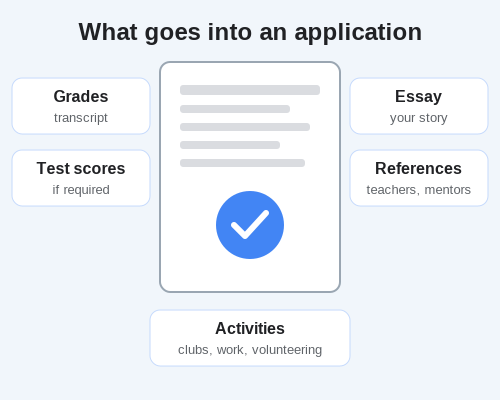
The building blocks of most applications
Start by building a short list of courses and institutions. For each one, note down:
- Entry requirements, including grades and any required subjects or tests
- Application deadlines, which can differ between institutions and courses
- Essay questions or personal statement guidance
- Required documents, references, and any interviews, portfolios, or auditions
- Application fees, and whether fee waivers are available
A simple spreadsheet with one row per institution keeps everything in one place and prevents missed deadlines.
Step 2: Plan Your Timeline
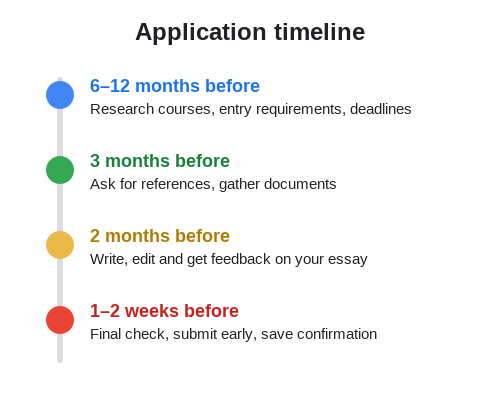
Work backwards from the deadline
Step 3: Write a Personal Essay That Sounds Like You
1
Brainstorm Real Moments
Don't start with "What do they want to hear?" Instead, list moments that shaped you: a problem you solved, a responsibility at home, a book or project that changed how you think, or a job that taught you something. Specific stories are far more memorable than general claims.
2
Show, Don't Just Tell
Instead of writing "I am passionate about engineering," describe what you did:
- "I spent two weekends rebuilding my grandfather's broken radio, and the moment it crackled back to life was when I knew I wanted to understand how things work."
3
Connect It to Your Course
Especially for subject-focused applications, explain why this subject matters to you and how you've explored it beyond the classroom: reading, online courses, projects, work experience, or competitions. Reflect on what you learned, not just what you did.
4
Edit Ruthlessly
Write a messy first draft, then improve it over several rounds. Cut clichés, repeated ideas, and long quotes. Read it aloud to catch awkward sentences. Ask one or two trusted people, such as a teacher or counsellor, for feedback, but keep it in your own voice.
Keep it honest and original
Never copy essays from the internet or let someone else write yours. Institutions use similarity checks, and plagiarism can lead to your application being rejected. If you use AI tools for brainstorming or proofreading, check each institution's policy first and make sure the final words are genuinely yours.
Step 4: Get Strong References
- Choose teachers or mentors who know you well, not just the most senior person.
- Ask politely and early, ideally in person.
- Give them a short summary of your achievements, goals, and the courses you're applying to.
- Send a thank-you note afterwards, whatever the outcome.
Step 5: Present Your Activities Clearly
Quality matters more than quantity. One long-term commitment with clear responsibility often impresses more than ten short-lived clubs. For each activity, describe your role and a concrete result: "Organised a fundraising bake sale that raised £450 for the school library" is stronger than "Member of charity club." Part-time jobs and family responsibilities count too.
Step 6: Final Checks Before Submitting
- Proofread every section, including names and course codes
- Check word or character limits for each essay
- Make sure your email address is professional and that you check it regularly
- Submit a few days early in case of technical problems
- Save or screenshot the confirmation for each application
A Simple Structure for Your Personal Essay
If you're staring at a blank page, this four-part structure works for most personal essays and statements:
1
Open With a Specific Moment
Start inside a real scene, not with a general statement.
- Weak: "Ever since I was young, I have always been interested in medicine."
- Stronger: "The night my grandmother's blood sugar crashed, I watched a paramedic calmly explain every step to my panicking family."
2
Give the Context Briefly
Explain why that moment mattered, in two or three sentences. Don't spend half the essay on background.
3
Show What You Did and Learned
This is the heart of the essay. Describe the actions you took afterwards, such as reading, volunteering, projects, or a job, and what each one taught you. Reflection ("I realised...", "This changed how I...") is what admissions readers look for.
4
Connect to Your Future
End by linking your experiences to the course and what you hope to do with it. Keep it grounded and specific rather than grand.
Common Application Mistakes
- Writing what you think admissions "want to hear" instead of your own story
- Listing achievements in the essay that already appear elsewhere in the application
- Using the wrong institution's name in a reused essay
- Ignoring the exact question or prompt
- Leaving references until the last week
- Missing deadlines because of time zones; deadlines are often in the institution's local time
- Not checking your email or application portal after submitting
After You Submit
- Check your portal regularly for missing documents, interview invitations, or extra questions.
- Apply for financial support separately if needed; student finance and scholarship forms often have their own deadlines. See our guide on applying for scholarships.
- Prepare for interviews by rereading your essay and practising answers about your subject.
- Compare offers carefully: look at total costs, conditions attached to offers, and reply deadlines.
- If you're waitlisted, follow the institution's instructions; some welcome a short update letter, others don't.
Final Thoughts
A strong application is organised, honest, and specific. Start early, tell real stories, and let your interest in the subject come through. Whatever happens, the reflection you do during the process will help you in interviews, scholarships, and future job applications too.