
Young adult writing on exam paper in classroom setting, focus on pencil and paper
This guide explains where to find papers legally and for free, and how to use them properly; simply looking at answers isn't enough.
Where to Find Sample and Past Papers
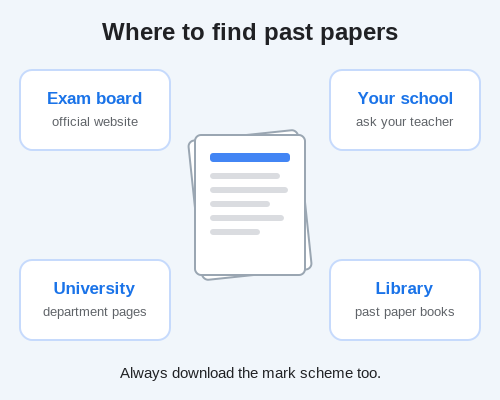
Official sources come first
1
Your Exam Board's Official Website
Most exam boards and testing organisations publish past papers, specimen (sample) papers, and mark schemes on their websites, usually in a "past papers" or "assessment resources" section. Some recent papers may be released to students only after a delay, or available through your school.
2
Your School or Teacher
Teachers often have access to more recent or secure papers and can provide mock exams. Ask them which papers to prioritise and whether they'll mark one for you.
3
University Departments
Many universities make past exam papers available through their library or course pages for enrolled students. Check your library's website or ask your lecturer.
4
Official Test Organisations
For standardised tests, such as university entrance or language tests, the official test provider usually offers free sample tests or practice questions. Start there before buying anything.
5
Libraries and Revision Books
Libraries often stock collections of past papers with worked solutions. These are useful for subjects where official answers are brief.
Always get the mark scheme
A paper without its mark scheme is only half as useful. Mark schemes show exactly which points earn marks, and examiner reports explain where students commonly lose them.
Watch out for "leaked" papers
Never buy or download papers claiming to be upcoming exams. They're almost always scams, and using genuinely leaked material can lead to serious penalties. Stick to official past and sample papers.
How to Use Past Papers: A Proven Method
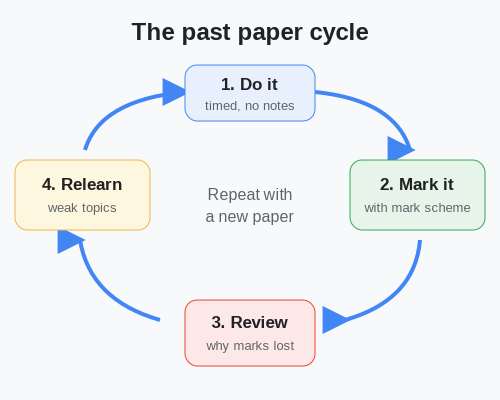
Do, mark, review, relearn, repeat
1
Learn the Content First
Early in your revision, use individual questions on topics you've just studied. Save full papers for when you've covered most of the syllabus.
2
Do It Under Real Conditions
Set a timer for the real exam length, close your notes, and put your phone away. This builds stamina and shows you how to manage time.
3
Mark It Honestly
Use the official mark scheme and be strict. If an answer is "almost" right, think about whether it would really earn the mark.
4
Analyse Your Mistakes
Sort every lost mark into a category:
- Knowledge gap: you didn't know the content
- Exam technique: you knew it but didn't answer the question as asked
- Careless error: misreading, calculation slips, or running out of time
5
Fix the Gaps and Repeat
Relearn weak topics, then redo the questions you got wrong a few days later. Keep a log of your scores to see progress, and move on to a new paper.
Extra Tips
- Notice command words like "describe," "explain," "evaluate," and "compare," because each needs a different kind of answer.
- Check how many marks each question is worth to judge how much to write.
- Save one or two recent papers for a final full mock shortly before the exam.
- Don't memorise past answers; exams change, but question styles repeat.
How to Read a Mark Scheme
Mark schemes can look confusing at first. Here's what to look for:
- Marking points: each specific fact, step, or idea that earns a mark. A 4-mark question usually needs four distinct points.
- Accept / do not accept lists: show which wordings are allowed and which common answers are too vague.
- Method marks: in maths and science, you can earn marks for correct working even if the final answer is wrong, so always show your steps.
- Level descriptors: for essays, answers are placed in bands (for example, Level 1 to Level 4) based on quality. Read what separates the top band from the next one down.
- Examiner reports: published separately by many exam boards, they explain the mistakes students most often made.
Pro tip
Rewrite one of your lower-scoring answers using the mark scheme's exact points, then compare the two versions. This shows you precisely what examiners reward.
A Sample 6-Week Past Paper Plan
1
Weeks 1–2: Topic Questions
Pull individual questions by topic from older papers. Focus on your weakest topics and check answers immediately.
2
Weeks 3–4: Untimed Full Papers
Complete one full paper per subject each week, without strict timing, using notes only when completely stuck. Mark and log every error.
3
Week 5: Timed Papers
Switch to full exam conditions: real timing, no notes, no phone. Practise planning time per question based on marks.
4
Week 6: Final Mocks and Review
Do your saved recent papers as full mocks, then spend the remaining time reviewing your mistakes log rather than learning brand-new material.
Managing Time in the Exam
A simple rule: divide the total minutes by the total marks to get minutes per mark. For example, a 90-minute paper worth 80 marks gives just over one minute per mark, so a 6-mark question deserves roughly 6–7 minutes. Leave five minutes at the end to check your work. Practising with this rule on past papers makes it automatic on the day.
Mark Your Own Work Honestly
When you mark a past paper, be strict. Use the official mark scheme, give marks only for points you actually wrote, and note every mistake in a separate list so you can revise those topics.
Final Thoughts
Official past papers and mark schemes are free, powerful, and often underused. Get them from trusted sources, practise under real conditions, and spend as much time reviewing mistakes as answering questions. That cycle is one of the most reliable ways to raise your grades.