Detailed close-up of a handwritten mind map on lined paper
Mind maps are great for summarising chapters, revising for exams, and planning essays. This guide shows you how to build one step by step and how to use it to actually remember the material.
Why Mind Maps Help
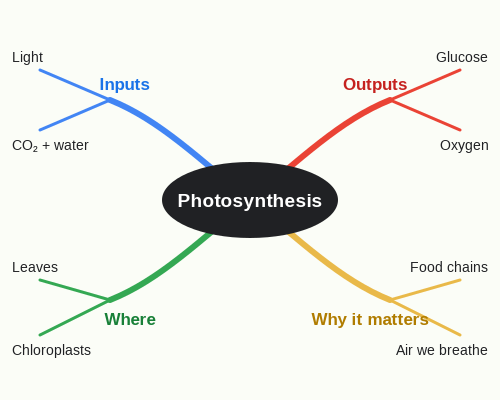
A mind map shows a whole topic at a glance
- They show structure: you see how ideas fit together, not just isolated facts.
- They force you to summarise: using keywords means you have to understand and choose what matters.
- They're quick to review: one page can replace several pages of notes.
- They work well for self-testing: you can redraw a map from memory and check what you missed.
Good to know
Mind maps aren't magic for everyone or every subject. They shine for topics with many connected ideas, like biology, history, or literature themes. For step-by-step processes, like solving maths problems, worked examples and practice usually help more.
How to Create a Mind Map Step by Step
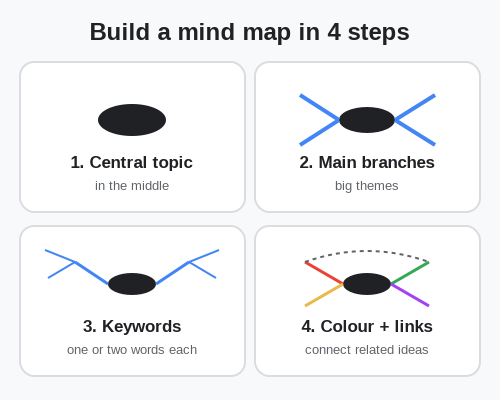
From one topic to a full map
1
Put the Main Topic in the Centre
Write the topic in the middle of the page and circle it, or draw a small image. Starting in the centre gives you space to branch out in every direction.
2
Add Main Branches
Draw thick branches for the main subtopics, usually between three and seven. Your syllabus, chapter headings, or the key questions about a topic (what, why, how, where, effects) are good sources.
3
Add Details With Keywords
From each main branch, draw thinner branches with details: definitions, examples, dates, or formulas. Use one or two words per branch, not full sentences. Keywords trigger memory better than paragraphs.
4
Use Colour, Images, and Links
Give each main branch its own colour. Add small sketches or symbols for important ideas. Draw dotted lines between related ideas on different branches; spotting these connections is where deeper understanding happens.
5
Check It Against Your Notes
Compare your map with your textbook or syllabus to make sure nothing important is missing, and correct any mistakes.
A Worked Example
Imagine you're revising photosynthesis. Your map might look like this:
- Centre: Photosynthesis
- Inputs: light energy, carbon dioxide, water
- Outputs: glucose, oxygen
- Where: leaves, chloroplasts, chlorophyll
- Factors: light intensity, CO₂ concentration, temperature
- Why it matters: food chains, oxygen in the air
A dotted line from "Outputs: oxygen" to "Why it matters: air we breathe" shows a connection you'd want to mention in an exam answer.
Paper or Digital?
Paper is quick, flexible, and free of distractions, and drawing by hand can help memory. Digital tools make it easy to edit, rearrange, and share maps, and many have free versions. Try both and use whichever you'll actually keep using.
How to Revise With Mind Maps
- Redraw from memory: on a blank page, recreate the map, then compare and fill in gaps in a different colour.
- Explain it aloud: talk through each branch as if teaching someone.
- Plan essays: put the question in the centre and your arguments on the branches.
- Combine with practice questions: use the map to review, then test yourself with real questions.
Using a Mind Map to Plan an Essay
Mind maps are excellent for planning essays because they let you see all your ideas before choosing an order. For example, for the question "Was the Industrial Revolution mainly positive for workers?":
- Centre: the essay question
- Branch 1, positives: new jobs, cheaper goods, growth of towns
- Branch 2, negatives: long hours, child labour, unsafe factories, poor housing
- Branch 3, change over time: factory laws, trade unions, rising wages later
- Branch 4, evidence: key dates, statistics, named examples
Next, number the branches in the order you'll write about them and decide your overall argument. A five-minute map like this often saves time and produces a clearer, better-balanced essay.
Common Mind-Mapping Mistakes
- Writing full sentences: the map becomes cluttered and loses its at-a-glance benefit.
- Too many main branches: more than seven makes the structure hard to remember; group them.
- Copying a map from a book: most of the benefit comes from creating it yourself.
- Spending too long decorating: colour helps, but artwork isn't the goal.
- Never testing yourself: a map you only look at is less effective than one you redraw from memory.
Handling Big Topics
For a large unit, create one overview map with the main topics only, then a separate detailed map for each topic. Number them to show how they connect, such as Map 1 (overview), Map 1.1, Map 1.2, and so on. This keeps each page readable while showing the whole course structure.
Use Mind Maps in Study Groups
Mind maps work well for group revision. Give everyone a large sheet of paper and one central topic, and take turns adding branches. Comparing maps shows gaps in understanding and helps everyone remember the links between ideas. Online whiteboards make this easy for remote study groups too. Afterwards, each person can redraw the map from memory as a quick test.
Teachers and tutors can also use mind maps to introduce a new topic, giving students a clear overview before details. Keep finished maps in a folder by subject so you can revisit them before exams; a quick five-minute review of a map is one of the fastest ways to refresh a whole topic.
Final Thoughts
Mind maps turn long notes into clear, connected pictures of a topic. Start in the centre, branch out with keywords, use colour and links, and most importantly, practise redrawing them from memory. Used this way, they become a powerful revision tool rather than just a pretty page.