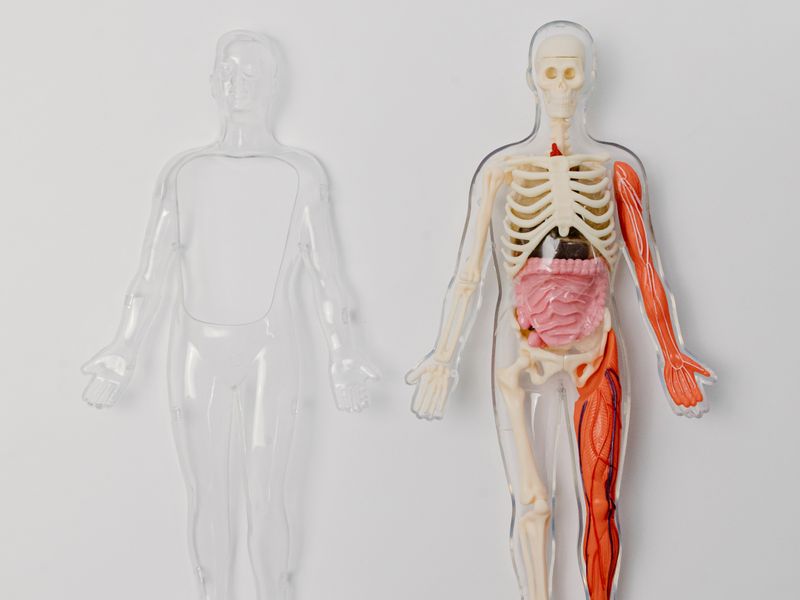
Models and diagrams make structures easier to picture
Anatomy has a reputation for being difficult because there is so much to learn: hundreds of bones, hundreds of muscles, and a whole new vocabulary. But with the right approach, it becomes logical and memorable. This guide shares practical study strategies used by successful students.
Step 1: Study One System at a Time
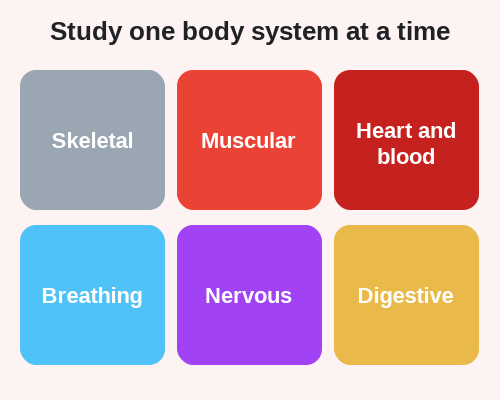
Breaking anatomy into systems makes it manageable
Step 2: Learn the Language of Anatomy
Anatomy uses precise terms, many from Latin and Greek. Learning the building blocks makes new words easier to understand and remember.
- Directional terms: anterior (front), posterior (back), superior (above), inferior (below), medial (towards the middle), lateral (towards the side), proximal and distal (nearer to or further from where a limb attaches).
- Body planes: sagittal, coronal (frontal), and transverse, which describe how the body is "sliced" in diagrams and scans.
- Word parts: for example, "cardio" means heart, "pulmo" lung, "osteo" bone, and "-itis" inflammation.
- Anatomical position: all descriptions assume a person standing upright, facing forward, palms forward.
Step 3: Use Visual and 3D Resources
- Atlases and textbooks: labelled illustrations remain essential references.
- 3D anatomy apps: let you rotate structures, peel away layers, and see relationships between parts. Several reputable apps offer free versions.
- Models: plastic skeletons and organ models help you understand size and position.
- Your own body: feel bony landmarks like your collarbone, kneecap, and spine, and contract muscles to see which move.
- Draw it yourself: sketching structures from memory, even roughly, is one of the most powerful ways to learn.
Colour-code your drawings
Use consistent colours, such as red for arteries, blue for veins, yellow for nerves, and brown for muscles. Colour coding makes complex diagrams easier to recall.
Step 4: Practise Active Recall and Spaced Repetition
Re-reading notes feels productive but isn't very effective. Testing yourself is far better for long-term memory.
- Flashcards: use paper cards or apps with spaced repetition, which show difficult cards more often.
- Blank diagrams: label unlabelled diagrams from memory, then check and correct.
- Teach someone: explaining a structure aloud reveals gaps in your understanding.
- Practice questions: answer exam-style questions regularly, not just at the end of the course.
- Mnemonics: memorable phrases help with lists, such as the order of cranial nerves or carpal bones.
Our guide on making effective notes has more techniques that work well for anatomy.
Step 5: Connect Structure to Function
Anatomy is much easier to remember when you understand why structures are shaped the way they are. Ask what each structure does, what it connects to, and what would happen if it were damaged. For example, the heart's left ventricle has a thicker wall than the right because it pumps blood around the whole body. Linking anatomy with physiology, how the body works, and with real clinical examples, such as common injuries, turns lists of names into a connected story.
Build a Study Plan
Study anatomy little and often, ideally daily, rather than cramming. Plan which system or region you'll cover each week, schedule regular review sessions, and mix reading, drawing, flashcards, and practice questions. Study groups are valuable for quizzing each other and discussing difficult areas. Free online courses and university lecture videos can supplement textbooks; see our guide on learning biology online for trusted platforms.
Learning, not self-diagnosis
Studying anatomy is a great way to understand your body, but it isn't a substitute for medical advice. If you have symptoms or health concerns, speak to a qualified doctor rather than trying to diagnose yourself.
Common Mistakes When Studying Anatomy
One of the most common mistakes is trying to memorise long lists of names without context. Without understanding where structures sit and what they do, names quickly blur together and are forgotten after an exam. Another is relying on a single resource. Textbook diagrams are two-dimensional, while the body is three-dimensional, so combining diagrams with 3D apps, models, and your own drawings gives a much clearer picture.
Many students also leave revision too late. Anatomy builds on itself: understanding the bones of the arm makes it easier to learn the muscles that attach to them, which in turn helps you understand the nerves and blood vessels that supply those muscles. Falling behind early makes later topics harder. Regular short reviews, even ten minutes a day, keep earlier material fresh and make each new topic easier to connect.
Finally, avoid passive study habits like highlighting whole pages or watching videos without pausing to test yourself. Active methods, such as labelling blank diagrams, explaining structures aloud, and answering practice questions, feel harder but lead to far better long-term memory. If you find a topic particularly difficult, try a different resource or ask a tutor or study partner to explain it another way.
Online and in-person anatomy communities can also help. Study groups, university anatomy societies, and reputable online forums let you share mnemonics, quiz each other, and discuss tricky regions. Explaining structures to others and hearing different ways of remembering them often makes difficult topics finally click.
Consistency matters more than marathon sessions.
Final Thoughts
Studying human anatomy effectively means breaking it into systems, learning the terminology, using diagrams, models, and 3D apps, testing yourself with active recall and spaced repetition, and connecting each structure to its function. Study a little every day, and the human body will gradually become a familiar, fascinating map.