
A student takes notes in a classroom in Buenos Aires
This guide covers what makes notes useful, proven note-taking methods, and simple habits that turn notes into real learning.
What Makes Notes Effective
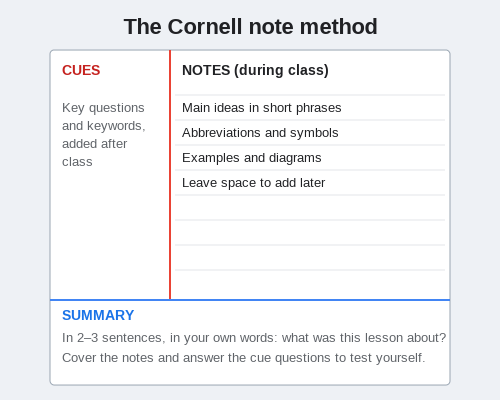
The Cornell method page layout
- Your own words: rephrasing forces you to understand, rather than just copy.
- Key ideas, not everything: capture main points, definitions, examples, and anything the teacher repeats or emphasises.
- Clear structure: headings, short bullet points, and space between sections.
- Visual cues: arrows, boxes, and simple diagrams to show relationships.
- Room for questions: mark anything you don't understand to check later.
Paper or laptop?
Both can work. Typing is faster, which can tempt you to copy word for word, while handwriting naturally pushes you to summarise. Whichever you use, focus on processing ideas, not transcribing speech.
Proven Note-Taking Methods
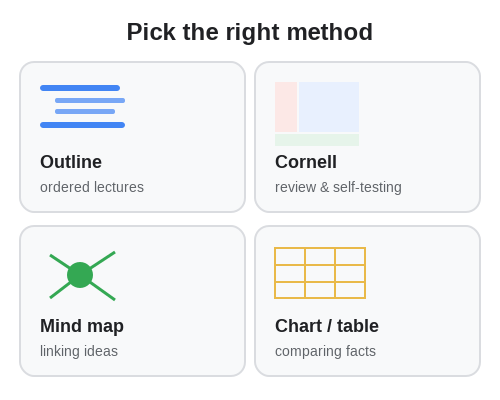
Different methods suit different content
1
The Cornell Method
Divide your page into three parts:
- Notes column (right): write the main notes during the lesson.
- Cue column (left): after class, add questions and keywords that match the notes.
- Summary (bottom): write a two- or three-sentence summary in your own words.
To revise, cover the notes and answer the cue questions. It's a built-in self-test.
2
The Outline Method
Use headings and indented bullet points to show main ideas and supporting details. It works well for well-organised lectures and textbook chapters.
3
Mind Mapping
Start with the main topic in the centre and branch out into subtopics. It's ideal for seeing connections between ideas and for planning essays. See our guide on creating mind maps for studying.
4
The Charting Method
Use a table with columns for different categories, such as dates, causes, and effects in history, or features of different systems in science. It makes comparisons easy to see.
Tips for Taking Notes in Class
- Review the previous lesson's notes for a few minutes beforehand
- Write the date and topic at the top of each page
- Use consistent abbreviations, such as "e.g.", "→" for leads to, "∴" for therefore
- Listen for signal phrases like "the key point is" or "this will be in the exam"
- Leave gaps to fill in missed points later from the textbook or a classmate
Review: The Step Most People Skip
We forget a large part of new information within days unless we revisit it. A simple review routine makes a big difference:
- Same day: spend 10 minutes tidying notes, filling gaps, and adding cue questions.
- A few days later: test yourself using the cues without looking at the notes.
- Weekly: write a one-page summary of the week's topics from memory, then check it.
- Before exams: condense your notes into flashcards or a single summary sheet per topic.
Common Mistakes
- Copying slides or textbooks word for word
- Highlighting almost everything, so nothing stands out
- Spending more time making notes look pretty than understanding them
- Never looking at notes again until the night before an exam
Example: Weak Notes vs. Effective Notes
Imagine a teacher explaining the water cycle.
Weak notes
- "The water cycle is the continuous movement of water on, above and below the surface of the Earth and it involves several processes which include evaporation which is when the sun heats up water..." (copied word for word, one long block)
Effective notes
- Water cycle = continuous movement of water
- Evaporation: sun heats water → vapour
- Condensation: vapour cools → clouds
- Precipitation: rain, snow, hail
- Collection: rivers, oceans, groundwater
- Q: What drives the cycle? (the sun's energy)
The second version is shorter, organised, uses arrows, and includes a self-test question. It's quicker to review and easier to remember.
Taking Notes From Textbooks: The SQ3R Method
Notes from reading work best when you engage with the text before writing. The well-known SQ3R method helps:
- Survey: skim headings, summaries, and diagrams to see the big picture.
- Question: turn each heading into a question, such as "What causes inflation?"
- Read: read one section at a time to answer your question.
- Recite: close the book and write the answer in your own words. These are your notes.
- Review: at the end, go through all your questions again and check your answers.
Digital Note-Taking Tips
- Use one app and one folder structure, organised by subject and topic
- Name notes consistently, such as "Biology – Cells – 2025-03-14"
- Add screenshots of diagrams, but annotate them in your own words
- Turn off notifications during class to avoid distractions
- Back up your notes to cloud storage so you never lose a term's work
Organise and Store Your Notes
Even excellent notes are useless if you can't find them when you need them. A simple system keeps them accessible:
- One folder or notebook per subject, with dividers or tabs for each topic.
- Date and title every page, plus the lesson number or chapter.
- Add a contents page at the front of each notebook, updated as you go.
- Use consistent file names for digital notes, such as "Biology - Cells - Lesson 3".
- Back up digital notes to cloud storage so nothing is lost if a device fails.
At the end of each topic, create a one-page summary sheet. These summaries become your main revision tool before exams.
Remember that the best note-taking method is the one you will actually use and review. Try two or three methods for a few weeks each, notice which helps you remember and understand most, and stick with it. Consistency matters more than perfect technique, and regular review turns good notes into real learning that lasts until exam day and beyond.
Final Thoughts
Effective notes are a tool for thinking and remembering, not a record of everything said. Write less, in your own words, use a method that suits the material, and review regularly by testing yourself. Your future self, the one revising for exams, will thank you.