
Flat lay of a pink-themed workspace featuring an alarm clock, calendar, pen, and paper
This guide brings together proven time-management methods into one practical system you can start this week.
Step 1: Find Out Where Your Time Goes
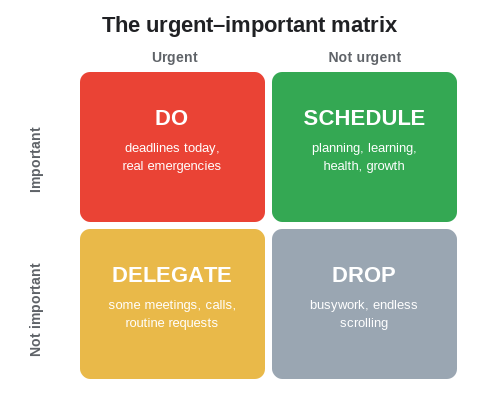
Not everything urgent is important
For three to five working days, note what you do in 30-minute blocks, either on paper or in a simple time-tracking app. Most people are surprised by how much time goes on email, meetings, switching between tasks, and phone checking. Your phone's screen-time report is another eye-opening source. You can't improve what you haven't measured.
Step 2: Prioritise What Really Matters
The urgent-important matrix, often called the Eisenhower matrix, sorts tasks into four groups:
- Urgent and important: do these now, such as a deadline today or a real problem.
- Important, not urgent: schedule these. Planning, learning, building relationships, and health live here, and this is where long-term progress comes from.
- Urgent, not important: delegate, batch, or minimise these, like many interruptions and some requests.
- Neither: drop them where you can.
Each day, pick your top three priorities. If you complete only those, the day was a success.
Step 3: Time-Block Your Day
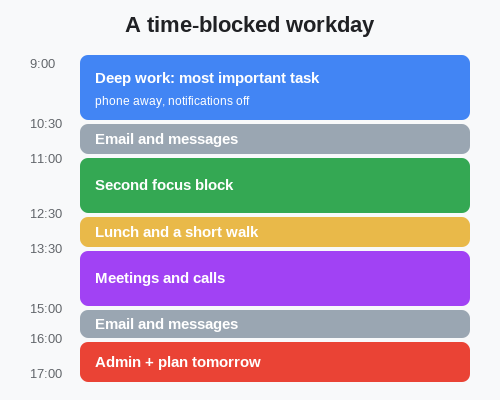
Give every hour a job
- Protect deep-work blocks of 60–90 minutes for your most important task, ideally when your energy is highest.
- Batch similar tasks: handle email and messages in two or three set blocks instead of all day.
- Leave buffers between blocks for overruns and breaks; plan only around 70–80% of your day.
- Group meetings together so they don't break up every focus period.
- End the day with planning: five minutes to set tomorrow's top three makes starting easier.
Estimate realistically
Most people underestimate how long tasks take. Track a few tasks to learn your real times, and add a buffer, perhaps an extra 25–50%, for new or complex work.
Step 4: Reduce Distractions and Procrastination
- Silence notifications during focus blocks and put your phone out of sight.
- Close unneeded tabs and apps; research on task switching shows that jumping between tasks costs time and attention.
- Use the two-minute rule: if a task takes under two minutes, do it now rather than tracking it.
- Start with five minutes: when procrastinating, commit to just five minutes. Starting is usually the hardest part.
- Break big tasks into small next actions, like "write the introduction" instead of "write the report."
- Use focused sprints, such as 25–50 minutes of work followed by a short break.
Step 5: Protect Your Time
- Say no, or not now, to requests that don't fit your priorities, politely and with an alternative where possible.
- Question meetings: ask for an agenda, suggest shorter slots, or offer an update by email instead.
- Delegate tasks others can do, with clear instructions and deadlines.
- Automate repetitive work. See our guide on automating office work.
- Protect rest: sleep, breaks, and time off aren't wasted time; tired people work slower and make more mistakes.
Step 6: Review Weekly
Spend 20–30 minutes each week reviewing what you finished, what slipped and why, and your main priorities for next week. Then block time for those priorities first, before the calendar fills with other people's requests. This one habit keeps the whole system working.
Manage Your Energy, Not Just Your Time
An hour when you're alert is worth far more than an hour when you're exhausted. Plan around your energy:
- Notice when you focus best, often mornings for many people, and protect that time for demanding work.
- Schedule routine tasks like email and admin for lower-energy periods.
- Take short breaks every 60–90 minutes to move, stretch, and rest your eyes.
- Eat regular meals and stay hydrated, since hunger and dehydration reduce concentration.
- Protect sleep; consistently short sleep hurts memory, focus, and decision-making.
- End work at a set time where possible, so rest helps you start strong tomorrow.
Simple Tools and Techniques to Try
You don't need complicated systems to manage time well. These proven techniques are simple to start and work for students, employees, and business owners alike.
- The Pomodoro Technique: work for 25 minutes, then take a 5-minute break. After four rounds, take a longer break. It helps with focus and starting difficult tasks.
- The two-minute rule: if a task takes less than two minutes, do it now rather than adding it to a list.
- Eat the frog: do your most important or most dreaded task first thing in the day, when your energy and willpower are strongest.
- Batching: group similar tasks, such as emails, phone calls, or errands, and do them together to reduce switching.
- The Eisenhower matrix: sort tasks into urgent and important, important but not urgent, urgent but not important, and neither. Focus on important work before it becomes urgent.
- A "done" list: at the end of each day, write down what you finished. It's motivating and helps you plan more realistically.
A calendar and one task list are usually enough. Our guide on using productivity apps explains how to set them up without overcomplicating things.
Remember that good time management isn't about filling every minute. Leave space for breaks, exercise, family, and rest. People who protect their downtime usually work more effectively, make fewer mistakes, and avoid burnout.
Be patient with yourself while you build new habits. Pick one technique, try it for two weeks, and keep what works. Small improvements repeated daily add up to hours saved every month.
Final Thoughts
Effective time management is less about squeezing in more and more about doing the right things with focus. Track your time, choose three daily priorities, block time for them, reduce distractions, protect your schedule, and review weekly. Small changes compound into much more productive, less stressful weeks.