
Two colleagues brainstorm ideas on a chalkboard in a modern office setting, discussing
The goal isn't to prove you're right. It's to find out the truth as early as possible. This guide shows you practical ways to test demand, from free conversations to small paid pilots.
Step 1: Write Down Your Key Assumptions
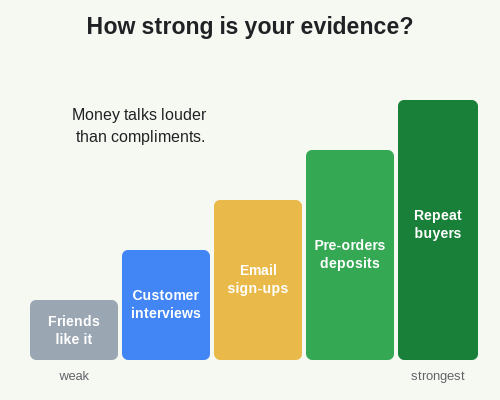
The strongest proof is payment
Every idea rests on assumptions. Write yours down so you can test them one by one:
- Problem: "Busy office workers struggle to find healthy lunches nearby."
- Customer: "They're aged 25–45 and work in the city centre."
- Solution: "They'd order pre-prepared healthy lunch boxes delivered to the office."
- Price: "They'd pay 8–10 per lunch."
- Channel: "We can reach them through office managers and workplace chat groups."
Start by testing the riskiest assumption, usually whether the problem is painful enough to pay to solve.
Step 2: Talk to Potential Customers
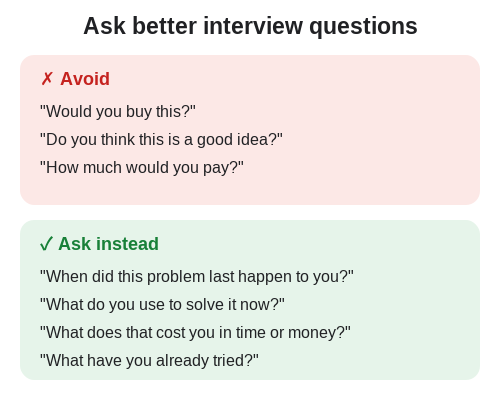
Ask about real past behaviour
- Ask when the problem last happened and what they did about it.
- Ask what they currently use and what it costs them in money or time.
- Listen for strong emotion and workarounds; these signal a real problem.
- Only describe your idea at the end, and watch for concrete interest, like asking when they can buy.
Warning sign
If people say "that's a great idea" but have never tried to solve the problem themselves, the need may not be strong enough. Compliments aren't evidence.
Step 3: Check Demand With Free Research
- Search trends: free trend tools show whether interest in a topic is growing, seasonal, or falling.
- Search suggestions and forums: the questions people type and post reveal real problems in their own words.
- Competitor reviews: lots of competitors usually means real demand; their negative reviews show what customers wish were better.
- Marketplaces: check how many similar products sell and at what prices.
Step 4: Run Low-Cost Tests
1
A Simple Landing Page
Create a one-page website describing the offer, price, and a clear button: "Join the waitlist" or "Pre-order." Share it with your target audience or run a small ad, then measure how many visitors sign up. A meaningful sign-up rate from real strangers is far stronger evidence than friends' opinions.
2
Pre-Orders or Deposits
Ask people to pay, or put down a refundable deposit, before the product is fully ready. Be completely transparent about delivery dates and refunds. Paying customers are the clearest validation possible.
3
A Manual Pilot
Deliver the service by hand to a few customers before building systems or apps. For the lunch idea, you might cook and deliver to one office for two weeks. You'll learn what customers actually value and what it really costs.
4
A Minimum Viable Product (MVP)
Build the simplest version that delivers the core benefit, then improve it based on feedback. Resist adding features until customers ask for them.
Step 5: Decide: Go, Change, or Stop
Before testing, decide what result would count as success, for example "30 waitlist sign-ups from 500 visitors" or "5 paying pilot customers." Then judge honestly:
- Go: clear demand and willingness to pay; plan the next stage.
- Change (pivot): interest exists but for a different customer, feature, or price. Adjust and test again.
- Stop: little real interest despite fair tests. Stopping early saves money and frees you for a better idea.
Example: Validating an Idea in Four Weeks
- Week 1: interview 12 target customers about the problem and how they solve it today.
- Week 2: build a one-page landing page describing the offer and price, with a waitlist form.
- Week 3: share it in two relevant online communities and spend a small, fixed amount on a targeted ad.
- Week 4: invite the most interested sign-ups to pre-order or join a paid pilot, then compare results with your success target.
Keep a simple log of every test: what you tried, how many people saw it, how many acted, and what you learned. Those numbers make the final decision far easier and more honest.
Signals That an Idea Has Real Demand
During validation, it's easy to hear what you want to hear. Friends say "great idea", and survey respondents say they "might" buy. Look for stronger signals that show genuine demand.
- People pay or pre-order: money is the clearest evidence. Even small deposits or paid pilots tell you far more than compliments.
- People give their time: signing up for a waitlist, joining a demo call, or completing a detailed survey shows real interest.
- People describe the problem without prompting: when potential customers bring up the problem themselves and explain how they solve it today, the pain is real.
- Existing workarounds: people using spreadsheets, hiring help, or combining several products to solve the problem show a gap you might fill.
- Repeat behaviour: customers who come back for a second test product or service are a strong sign.
Weak signals include likes on social media, polite encouragement from family, and survey answers about what people would do in the future. Treat them as encouraging, but not as proof.
Record what you learn in a simple validation log: what you tested, what happened, and what you'll do next. It keeps you honest and helps you explain your evidence to partners, lenders, or investors later.
Validation can save months of work and a lot of money. If the evidence isn't strong after a few honest tests, changing direction early is a success, not a failure.
Final Thoughts
Validation turns guesses into evidence. Write down your assumptions, talk to real customers about real behaviour, run cheap tests, and look for commitment, especially payment. A few weeks of validation can save months of building something nobody buys.