
A clean and organized workspace with an open laptop and notebooks on a white table
It doesn't need to be a 50-page document. Many small businesses start with a one-page plan and expand it only when needed, for example when applying for a loan. This guide explains what to include, how to estimate your numbers, and how to keep the plan useful.
Why You Need a Plan
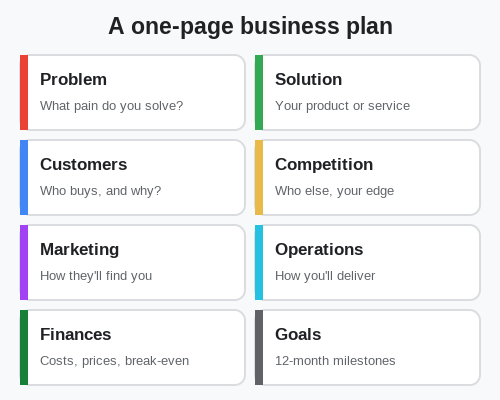
Start with a one-page plan
- Clarity: writing it down exposes gaps, like an unclear customer or unrealistic prices.
- Funding: lenders and investors usually expect a plan with financial forecasts.
- Focus: clear goals help you say no to distractions.
- Measurement: you can compare real results against your forecast and adjust.
The Key Sections of a Business Plan
1
Executive Summary
A half-page overview: what you sell, to whom, why customers will choose you, how you'll make money, and what you need (for example, a loan amount). Write this last, even though it appears first.
2
Problem and Solution
Describe the customer problem in plain language, then your product or service and how it solves it. Include evidence of demand, such as interviews, pre-orders, or early sales.
3
Target Market
Who exactly are your customers, how many are there in your reachable area or niche, and what are they spending today? Be specific: "busy parents within 5 km who want healthy ready meals" is better than "everyone who eats."
4
Competition
List direct and indirect competitors, their prices and strengths, and your advantage. Never claim "we have no competition"; customers always have some alternative, even if it's doing nothing.
5
Marketing and Sales
How will customers find you, and how will you turn interest into sales? Include channels, budget, pricing, and your plan for the first 10 or 100 customers.
6
Operations and Team
Where you'll work, suppliers, equipment, delivery, key processes, and who does what. Mention any licences, insurance, or legal requirements.
7
Financial Plan
Startup costs, a 12-month sales forecast, monthly costs, cash flow, and break-even point. This is the section lenders read most carefully.
Working Out Your Break-Even Point
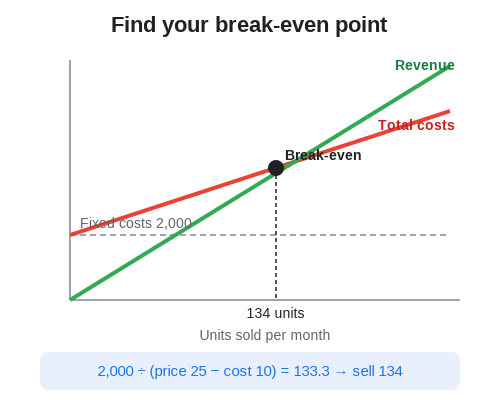
The point where you stop losing money
Break-even units = fixed costs ÷ (price − variable cost per unit)
Example: monthly fixed costs (rent, software, insurance) are 2,000. You sell a product for 25, and each one costs 10 to make and deliver. Each sale contributes 15 towards fixed costs, so you need 2,000 ÷ 15 = 133.3, or 134 sales a month, to break even. Everything after that is profit.
If the break-even number looks unrealistic, adjust the plan: raise prices, lower costs, or rethink the product before spending money.
Forecasting Sales and Cash Flow Realistically
- Build from the bottom up: "50 enquiries a month, 20% convert, average order 40" is more believable than "1% of a huge market."
- Assume slower growth than you hope; most businesses take longer to reach steady sales.
- Plan cash flow monthly: profit on paper isn't cash in the bank. Late-paying customers and upfront stock purchases can cause shortfalls even in profitable businesses.
- Create three scenarios: cautious, expected, and optimistic, so you know how long your money lasts in a slow case.
Common Business Plan Mistakes
- Vague customer descriptions and inflated market sizes
- Forgetting costs such as tax, insurance, payment fees, and your own salary
- Writing it once and never looking at it again
- Too much jargon; plain language persuades better
- No evidence that customers actually want the product
Review your plan every three months, compare forecasts with actual numbers, and update it. A living plan is far more useful than a perfect one in a drawer.
Example: A One-Page Plan for a Home Bakery
- Problem: local offices struggle to find fresh, affordable treats for meetings and celebrations.
- Solution: pre-ordered boxes of homemade cakes and pastries, delivered within 5 km.
- Customers: office managers and event organisers at around 40 nearby businesses.
- Competition: supermarkets (cheap, less fresh) and cafés (fresh, expensive). Edge: fresh, reliable delivery, and mid-range prices.
- Marketing: free samples to 10 offices, a business listing, and a simple order website.
- Finances: startup costs about 1,000, monthly costs about 600, average order 45, so roughly 14 orders a month to cover monthly costs.
- Goals: 20 regular business customers within 12 months.
Notice how every line is specific and measurable. That clarity is what makes a plan useful.
Use and Update Your Plan
A business plan is most valuable when it becomes a working tool rather than a document filed away after a bank meeting.
- Compare plan with reality monthly: check actual sales, costs, and cash against your forecasts. Large differences show where assumptions need changing.
- Update forecasts quarterly: roll your forecasts forward and adjust for what you've learned.
- Set milestones: such as your first ten customers, breaking even, or hiring your first employee, and track progress towards them.
- Revisit the plan before big decisions: new premises, large purchases, loans, or new products should all be tested against your plan.
- Get feedback: ask a mentor, accountant, or local business support service to review your plan. A fresh pair of eyes often spots risky assumptions.
Many countries offer free business planning templates and advice through government small business services, banks, and enterprise agencies. These can help you structure your plan and understand local requirements.
Keep different versions for different readers. A lender may want detailed financial forecasts and security information, while a potential partner may care more about the market and your strategy. The underlying plan stays the same; the emphasis changes.
Final Thoughts
A good business plan is clear, honest, and based on real evidence. Start with a one-page version, check your break-even point, forecast conservatively, and update it as you learn. Whether or not you ever show it to an investor, it will help you make better decisions.